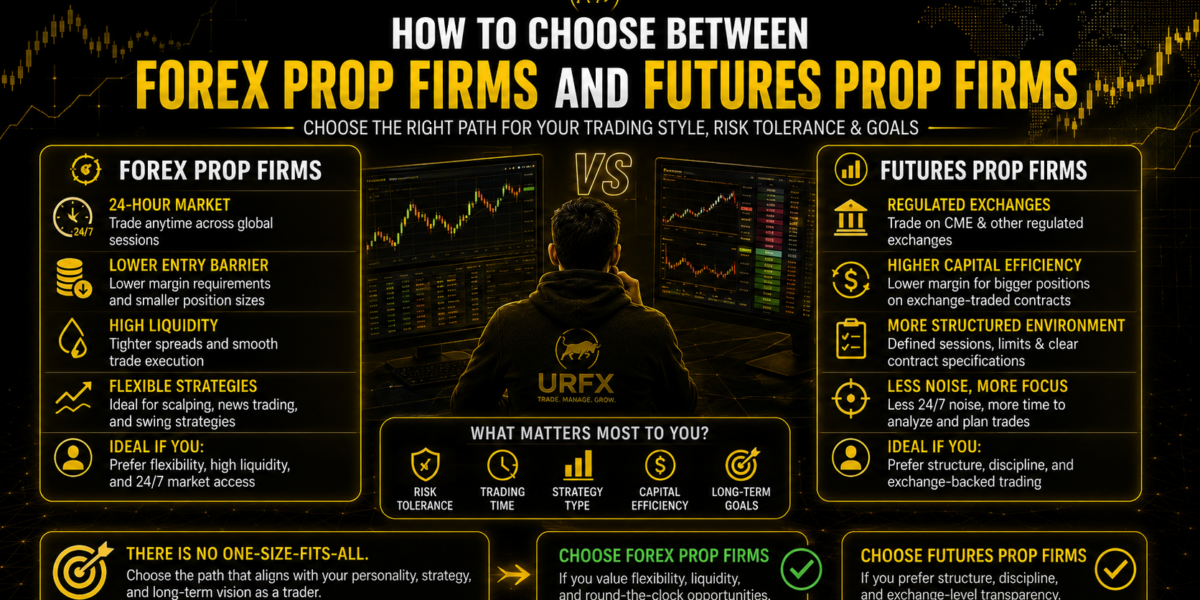
Forex Prop Firms and Futures Prop Firms represent two distinct pathways for traders pursuing proprietary trading and funded trading careers. Choosing between Forex Prop Firms and Futures Prop Firms is a critical decision for anyone seeking a funded account through a trading challenge, structured trading strategy, and defined evaluation process.
Forex trading operates within the foreign exchange market, while futures trading takes place in the futures market, often through regulated exchanges such as the Chicago Mercantile Exchange (CME). Understanding the differences between Forex Prop Firms and Futures Prop Firms helps traders compare their advantages, challenges, trading conditions, and long-term opportunities.
This comprehensive guide explains how to choose between Forex Prop Firms and Futures Prop Firms by examining the key differences in market liquidity, margin requirements, trading sessions, regulatory requirements, trading psychology demands, and long-term profitability potential.
We’ll compare forex funding and futures funding options, explore how instant funding trading account, instant funded account prop firm, and prop firm instant funded account models differ between forex and futures, examine risk management tips specific to each market, understand why reasons traders fail prop firm challenges vary by market, discuss prop firm challenges and forex challenge vs futures challenge requirements, explore how trading psychology and emotional discipline differ between markets, and provide guidance on selecting the best prop firm for your trading career. Whether you’re a professional trader, retail trader, or aspiring funded trader, understanding these differences helps you make an informed choice .
Understanding Forex and Futures Markets
Forex Prop Firms and Futures Prop Firms operate in fundamentally different financial markets, each with its own structure, trading instruments, and execution conditions. While Forex firms provide access to currency pairs in the global foreign exchange market, futures firms focus on standardized contracts traded through regulated exchanges. Understanding how Forex Prop Firms and Futures Prop Firms differ in liquidity, trading hours, margin requirements, and market rules can help traders select the right environment. Ultimately, choosing between Forex Prop Firms and Futures Prop Firms depends on your trading strategy, risk tolerance, preferred market structure, and long-term goals.
The Forex Market and Currency Trading
The foreign exchange market (forex) is a 24-hour market where traders buy and sell major currency pairs like EUR/USD, GBP/USD, and USD/JPY. The currency market is the world’s largest global financial markets with trillions in daily volume. Forex trading offers flexible trading hours and market accessibility across multiple trading sessions (Asian, European, American) .
The Futures Market and CME
The futures market consists of standardized contracts traded on regulated exchanges such as the Chicago Mercantile Exchange (CME). When comparing Forex Prop Firms and Futures Prop Firms, traders should understand that futures contracts come with clearly defined contract specifications, expiration dates, tick values, and contract-size requirements. Unlike decentralized forex trading, exchange-traded futures contracts follow strict exchange rules and regulatory standards. These structural differences are important when evaluating Forex Prop Firms and Futures Prop Firms, particularly in relation to transparency, margin requirements, trading sessions, and risk management. Understanding how Forex Prop Firms and Futures Prop Firms operate can help traders choose the market that best matches their strategy and trading preferences.
Market Accessibility and Entry Barriers
Forex Prop Firms and Futures Prop Firms often differ significantly in their entry requirements and access to trading capital. Forex prop firms typically offer a lower entry barrier, accessible trading conditions, and more flexible capital requirements. In contrast, futures prop firms may use more structured account sizes, contract limits, and funding conditions. When comparing Forex Prop Firms and Futures Prop Firms, retail traders often find forex funding more accessible due to smaller position sizes and flexible challenge options. However, the right choice between Forex Prop Firms and Futures Prop Firms depends on the trader’s available capital, preferred market structure, risk tolerance, and long-term funding goals.
Key Differences: Margin, Leverage, and Capital
Margin requirements, drawdown limits, trailing drawdown, maximum drawdown, and capital scaling differ significantly between markets.
Margin Requirements and Leverage
Forex trading typically offers higher leverage (50:1 to 100:1) with lower margin requirements and better capital preservation. Futures trading typically offers lower leverage (10:1 to 20:1) with higher margin requirements and risk exposure. Margin calls are more common in futures trading due to higher margin requirements and daily price limits .
Position Sizing and Lot Sizes
Lot sizes in forex (standard = 100,000 units) are different from futures contracts (contract size varies by product). Position sizing calculations differ between markets. Forex Prop Firms allow more flexible position sizing while Futures Prop Firms enforce strict contract size limits .
Capital Scaling and Account Growth
Capital scaling in forex funding programs typically allows gradual account growth. Futures funding programs often have stricter account maintenance requirements and slower capital scaling .
Trading Sessions and Market Accessibility
Trading sessions and market hours differ dramatically.
24-Hour Forex Market
The forex market operates 24 hours with overlapping trading sessions across Asia, Europe, and America. Flexible trading hours allow traders to trade whenever they prefer. Market closures never occur in forex .
Futures Market Sessions and Restrictions
Futures markets have specific trading sessions with session limits, trading restrictions, and overnight restrictions. Market closures occur at the end of each trading day. Settlement prices are set at market close, affecting overnight positions .
Trading Accessibility and Opportunity
24-hour market access in forex provides continuous trading opportunity and market opportunity. Futures markets with session limits provide more structured but less flexible trading opportunity .
Market Volatility and Price Action
Market volatility and price swings affect trading psychology and execution.
Forex Market Volatility
Forex trading experiences relatively stable market volatility with smooth price swings. Tighter spreads in major currency pairs like EUR/USD provide smooth execution .
Futures Market Volatility and Price Limits
Futures trading experiences more extreme price swings and market volatility. CME price limits halt trading when prices move too far too fast. Daily price limits can prevent traders from exiting losing positions .
Slippage and Order Execution
Forex trading typically experiences less slippage with smooth execution. Futures trading can experience significant slippage and order rejections during volatile periods. Trading halts can occur, preventing trade execution .
Regulatory Requirements and Compliance
Regulatory requirements and trading rules differ between markets.
Forex Regulatory Framework
Forex trading is regulated by various national regulators but lacks centralized regulatory requirements. Transparent trading conditions and transparent rules vary by broker .
Futures Regulatory Framework
Futures trading is regulated by the CME and exchange rules are standardized. Trading compliance requirements are strict and uniform. Regulatory requirements are clearly defined .
Market Stability and Transparency
Futures markets offer market stability through standardized margin requirements and transparent trading conditions. Forex markets offer market accessibility but less market stability .
Trading Psychology and Emotional Demands
Trading psychology differs significantly between markets.
Emotional Pressure and Stress
Forex trading with 24-hour market access can create continuous emotional pressure and trading stress. Emotional discipline is constantly tested. Mental burnout is common .
Psychological Sustainability
Futures trading with defined trading sessions provides psychological sustainability through defined trading hours. Emotional resilience and mental resilience are easier to maintain with structured trading sessions .
Cognitive Load and Decision Making
24-hour forex markets create higher cognitive load and constant decision making pressure. Futures markets with session limits reduce cognitive load and allow mental recovery .
Trading Confidence and Consistency
Trading confidence and trading consistency are easier to maintain in futures trading with defined trading sessions. Emotional discipline is easier to enforce .
Prop Firm Evaluation and Funding Programs
Prop firm evaluation processes can vary significantly between Forex Prop Firms and Futures Prop Firms. Forex funding programs often assess traders through profit targets, maximum drawdown limits, minimum trading days, and consistency rules across one-step or multi-step challenges. Futures funding evaluations may focus more heavily on contract limits, trailing drawdown, daily loss limits, and approved trading sessions. When comparing Forex Prop Firms and Futures Prop Firms, traders should review each firm’s evaluation fees, trading objectives, payout conditions, and risk-management rules. Understanding how Forex Prop Firms and Futures Prop Firms structure their challenges can help traders choose an evaluation process that matches their strategy, experience, and trading discipline.
Forex Challenge vs Futures Challenge
Forex challenge programs offered by Forex Prop Firms and Futures Prop Firms often include defined profit targets, daily drawdown limits, and strict prop trading rules. Forex evaluations may require traders to reach an 8–10% profit target while remaining within a 5% daily drawdown limit and an overall maximum loss threshold. Futures challenge programs may use similar performance objectives but apply different contract specifications, trailing drawdown rules, position limits, and trading-session requirements. When comparing Forex Prop Firms and Futures Prop Firms, traders should carefully review how each evaluation calculates losses, profits, and consistency. Choosing between Forex Prop Firms and Futures Prop Firms ultimately depends on which challenge structure best aligns with the trader’s strategy and risk-management approach.
Funded Trader Programs
Funded forex trader programs provide profit split (typically 80/20) and capital scaling opportunities. Funded futures trader programs offer similar structures but with different account size requirements .
Performance Evaluation and Trading Objectives
Performance evaluation in forex funding focuses on trading consistency and long-term profitability. Futures funding evaluation emphasizes trading discipline and risk management .
Choosing Your Best Prop Firm
Selecting the best prop firm depends on your preferences.
Instant Funding vs Challenge Models
Instant funding trading account options are more common in forex prop firms. Instant funded account prop firm and prop firm instant funded account models are becoming available in futures prop firms as well .
Assessing Your Trading Style
Scalp traders and day traders often prefer forex prop firms due to 24-hour market access and professional execution. Swing traders and position traders may prefer futures prop firms with defined trading sessions and structured trading environment .
Risk Management Considerations
Risk management tips differ by market. Avoid overtrading in forex requires discipline due to 24-hour market access. Futures trading naturally limits overtrading through session limits .
Long-Term Success and Professional Development
Long-term profitability and sustainable growth depend on market choice.
Trading Mastery and Skill Development
Professional trading mastery requires understanding your chosen market. Trading mastery in forex requires managing 24-hour market psychology. Trading mastery in futures requires understanding contract specifications and exchange rules .
Sustainable Trading and Strategic Growth
Sustainable trading requires choosing a market that matches your trading psychology and emotional discipline capabilities. Strategic growth comes from long-term success in your chosen market with proper trading framework and trading environment .
Performance Improvement and Learning Curve
Performance improvement and trading efficiency in forex requires managing emotional pressure from 24-hour market access. Performance improvement and trading performance in futures requires understanding daily price limits and session limits .
Comparison: Forex vs Futures Prop Firms
Key differences summarized:
| Factor | Forex Prop Firms | Futures Prop Firms |
| Market Hours | 24-hour market | Session-based |
| Margin Requirements | Lower | Higher |
| Leverage | Higher (50:1-100:1) | Lower (10:1-20:1) |
| Spreads | Tighter | Variable |
| Volatility | Moderate | Higher |
| Accessibility | More accessible | More structured |
| Trading Sessions | Flexible | Defined |
| Emotional Pressure | Higher | Lower |
| Entry Barrier | Lower | Higher |
Important Disclaimer: This guide is provided for educational purposes only and does not constitute financial or investment advice. Past performance is not indicative of future results. Trading involves substantial risk, and you should only trade with capital you can afford to lose. Always consult with a qualified financial advisor before making trading decisions.