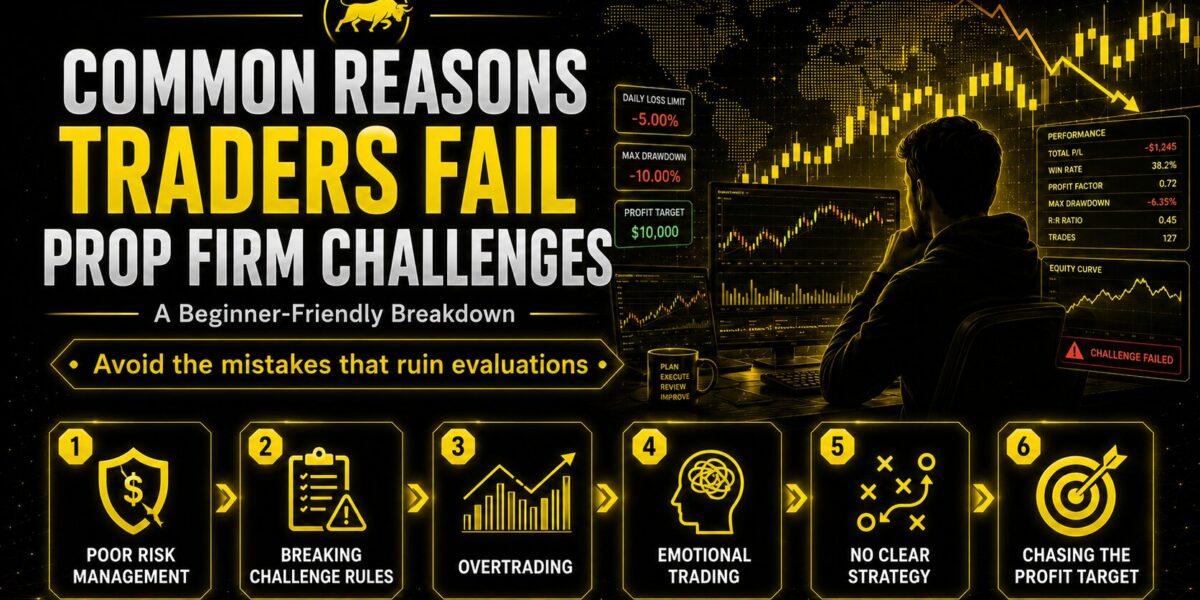
Prop firm challenges have become a popular pathway for traders seeking a funded trading account, but the reality is that most traders fail their prop trading challenges. Understanding the common reasons traders fail is critical for improving your challenge pass rate and achieving success in the funded stage. Reasons traders fail typically involve psychological factors, poor risk management, inadequate trading strategy execution, and misunderstanding challenge rules. Whether you’re trading through an Instant Funding Futures Prop Firm, a Futures Prop Firm with Instant Funding, or a No Challenge Instant Funding Prop Firm, understanding why traders fail helps you avoid the same mistakes. This comprehensive guide explores the primary reasons traders fail prop firm challenges, including psychological pressure, poor position sizing, inadequate trading discipline, overtrading, revenge trading, and trading psychology failures. We’ll examine how profit target achievement and daily loss limit violations lead to failure, how maximum drawdown, static drawdown, trailing drawdown, and daily drawdown limits are breached, how trading strategy incompatibility causes failure, how stop loss and take profit discipline prevents failure, how lot size in forex trading decisions impact success, how to avoid overtrading in forex, and how trading psychology determines challenge outcomes .
Understanding Prop Firm Challenge Failure Rates
Prop trading challenges have surprisingly low challenge pass rates, and understanding the main Reasons Traders Fail can help participants prepare more effectively. Poor risk management, emotional decision-making, overtrading, and breaking evaluation rules are among the most common Reasons Traders Fail. By identifying these Reasons Traders Fail early, traders can build a more disciplined strategy and improve their chances of securing a funded account.
Why Challenge Pass Rates Are Low
Challenge pass rates for prop firm challenges typically range from 5-15%, meaning 85-95% of traders fail their challenges. This low challenge pass rate reflects the difficulty of achieving consistent profitability under psychological pressure while adhering to strict challenge rules. Understanding why challenge pass rates are so low helps traders implement strategies to improve their odds .
The Cost of Failure
Each prop trading challenges failure costs the trader their challenge fee (typically $50-$300) and the opportunity cost of time spent on the challenge. Multiple challenge failures create financial and psychological burden that discourages traders from retrying. Account breach analysis after failure is critical for identifying what went wrong .
Challenge Pass Rate Statistics
Trading evaluation data shows that traders with prior trading edge and documented historical performance have higher challenge pass rates than traders without preparation. Prop challenge preparation and pre-session checklist completion significantly improve success rates .
Psychological Failures and Emotional Trading
Trading psychology is the primary reason traders fail prop firm challenges.Fear, greed, revenge trading, and emotional decision-making are common Reasons Traders Fail to follow their strategy and respect risk limits. Understanding these psychological Reasons Traders Fail can help traders remain disciplined and improve their chances of passing the evaluation.
Emotional Trading and Revenge Trading
Emotional trading driven by fear of losing and trading anxiety is one of the main Reasons Traders Fail prop firm challenges. These emotions can cause traders to abandon their trading strategy, make impulsive decisions, and ignore risk-management rules. Revenge trading after losses is another of the common Reasons Traders Fail, as it weakens trading discipline and can quickly lead to daily loss limit violations. The psychological pressure of the challenge environment intensifies these emotional responses, making poor emotional control one of the most important Reasons Traders Fail evaluations.
Overtrading and Impulsive Decisions
Overtrading is one of the most common reasons traders fail prop trading challenges. Deadline pressure to achieve the profit target drives traders to overtrade and enter marginal setups that don’t meet their entry criteria. Stress-based decision-making replaces logical rule-based trading system execution .
Loss Recovery and Revenge Trading Cycles
Loss recovery attempts through revenge trading create a destructive cycle. After a losing trade, traders feel compelled to immediately enter another trade to “get even.” This revenge trading behavior violates trading discipline and typically leads to larger losses. Consecutive losses amplify psychological pressure and trigger more revenge trading .
Risk Management and Drawdown Failures
Poor risk management is one of the main Reasons Traders Fail prop firm challenges, as oversized positions and inconsistent risk exposure can quickly cause drawdown violations. Ignoring daily and maximum loss limits is also among the most common Reasons Traders Fail evaluations. By controlling position sizes, setting clear stop losses, and protecting trading capital, traders can avoid the risk-management Reasons Traders Fail and improve their chances of passing the challenge.
Understanding Drawdown Limits
Maximum drawdown limits specify the maximum loss allowed during the challenge. Static drawdown limits are fixed percentages (e.g., 10% maximum loss). Trailing drawdown limits reset as the account equity reaches new highs. Daily drawdown limits specify the maximum daily loss. Overall drawdown limits specify the total loss allowed. Drawdown floor is the lowest the account can go before the challenge ends .
Position Sizing and Risk Per Trade
Poor position sizing based on risk per trade calculations is a primary cause of drawdown violations. Traders who don’t calculate lot size in forex trading properly or who increase position sizing after losses quickly exceed maximum drawdown limits. Capital preservation requires disciplined position sizing based on account size and risk per trade limits .
Account Balance and Equity Curve Management
Traders who don’t monitor their account balance and account equity carefully often exceed drawdown limits without realizing it. Equity highs should be tracked to calculate trailing drawdown properly. Equity curve analysis helps identify when drawdown limits are being approached .
Trading Strategy Incompatibility
Trading strategy incompatibility with challenge requirements is one of the main Reasons Traders Fail prop firm evaluations. A strategy may be profitable under normal market conditions but still conflict with strict drawdown limits, profit targets, or trading rules, creating additional Reasons Traders Fail. By adapting trade frequency, position sizing, and risk-to-reward rules to the evaluation structure, traders can reduce these strategy-related Reasons Traders Fail and improve their chances of passing.
Strategy Compatibility Issues
Some trading strategies are incompatible with prop firm challenges requirements. Low-frequency strategy traders may struggle to achieve the profit target within the evaluation window. High-expectancy strategy traders with high win rates but small profits per trade may struggle with daily loss limit management .
Entry Criteria and Trade Frequency
Traders who relax their entry criteria to increase trade frequency and reach the profit target faster often enter marginal setups that have poor risk-to-reward ratio. High-conviction trades based on strict entry criteria are more likely to succeed than marginal setups entered out of desperation. Trading timeframe selection should align with your trading strategy and average monthly return targets .
Strategy Execution Failures
Strategy execution failures occur when traders deviate from their rule-based trading system. Forced trades entered because of deadline pressure violate the trading strategy. Switching timeframes mid-challenge to find more trading opportunities disrupts strategy execution .
Violation of Challenge Rules
Rule breaches are among the most common Reasons Traders Fail prop firm challenges, as violating even one evaluation condition can result in immediate disqualification. Exceeding daily loss limits, trading during restricted periods, or ignoring position-size rules are frequent Reasons Traders Fail evaluations. By carefully reviewing and consistently following every challenge requirement, traders can avoid these rule-related Reasons Traders Fail and improve their chances of earning a funded account.
Moving Stop Losses and Changing Profit Targets
Moving stop losses after entry violates most challenge rules and demonstrates poor trading discipline. Changing profit targets mid-trade violates rule-based execution. Widening stop losses to avoid losses violates stop loss discipline .
Oversizing Positions and Increasing Risk After Losses
Oversizing positions beyond risk per trade limits violates challenge rules. Increasing risk after losses through averaging into losses or martingale strategy attempts violates risk management rules. Correlated positions that violate diversification rules can cause simultaneous losses .
Trading Outside Normal Conditions
News scalping during high-impact economic events violates many challenge rules. Trading outside normal conditions like during crypto market volatility spikes or intraday whipsaws increases failure risk. Market conditions should be considered when deciding whether to trade .
Market Conditions and Execution Failures
Market conditions and trade execution issues cause unexpected failures.
Slippage and Fill Quality
Slippage during volatile market conditions can cause stop loss orders to execute at worse prices than expected, violating risk per trade limits. Fill quality varies across brokers and market conditions, affecting actual losses versus planned losses .
Trading Variance and Losing Streaks
Short-term variance in trading results can create losing streaks that exceed daily loss limit or maximum drawdown limits. Long-term expectancy may be positive, but short-term variance can cause challenge failure before the long-term expectancy has time to play out .
Intraday Whipsaws and Volatility
Intraday whipsaws during market volatility can hit stop loss orders and then reverse, creating losses on trades that would have been winners. Trading variance during high-volatility periods increases the risk of exceeding daily loss limit or maximum drawdown limits .
Preparation and Evaluation Readiness
Inadequate prop challenge preparation leads to failure.
Pre-Session Checklist and Planning
Traders who don’t complete a pre-session checklist and pre-session trading plan are more likely to fail. Pre-session checklist should include: Are my entry criteria clear? Have I set my stop loss and take profit levels? Am I following my rule-based trading system? .
Trading Journal and Performance Review
Trade journal and trading journal maintenance and performance review help identify patterns in failures. Post-failure analysis of the equity curve and account breach analysis reveal what went wrong. Trading behaviour improvement requires understanding specific failure patterns. Tracking average monthly return helps assess strategy profitability .
Evaluation Readiness and Risk Framework
Evaluation readiness requires a solid risk framework and trading process that has been tested. Prop challenge preparation should include backtesting and demo trading to verify the trading strategy works under challenge conditions. Challenge retry after failure should incorporate lessons learned from post-failure analysis .
Specific Failure Scenarios
Common failure patterns emerge across traders.
Worst Single-Day Loss Violations
Many traders fail by exceeding the worst single-day loss limit on a single bad trade or series of trades. Oversizing positions and increasing risk after losses quickly lead to daily loss limit violations .
Account Longevity Issues
Account longevity failures occur when traders run out of capital before achieving the profit target. Profitability requires not just winning trades but also managing losing trades and consecutive losses without exceeding drawdown limits .
Equity Curve Breaches
Equity curve analysis reveals when traders are approaching maximum drawdown or daily loss limit violations. Traders who don’t monitor their equity curve carefully often exceed limits without realizing it until it’s too late .
Strategies for Improving Success Rate
Specific strategies improve challenge pass rate.
Stop Loss and Take Profit Discipline
Stop loss and take profit discipline prevents moving stop losses and changing profit targets mid-trade. Predetermined stop loss and take profit levels remove emotion from exit decisions and protect winning positions .
Avoiding Overtrading and Maintaining Discipline
Avoid overtrading in forex by sticking to your entry criteria and skipping marginal setups. Trading discipline requires patience to wait for high-conviction trades rather than forcing trades to meet deadline pressure .
Trading Psychology Mastery
Trading psychology training helps traders recognize emotional triggers and maintain trading discipline under psychological pressure. Fear of losing and trading anxiety can be managed through pre-session checklist completion and rule-based trading system adherence .
Important Disclaimer: This guide is provided for educational purposes only and does not constitute financial or investment advice. Past performance is not indicative of future results. Trading involves substantial risk, and you should only trade with capital you can afford to lose. Always consult with a qualified financial advisor before making trading decisions.