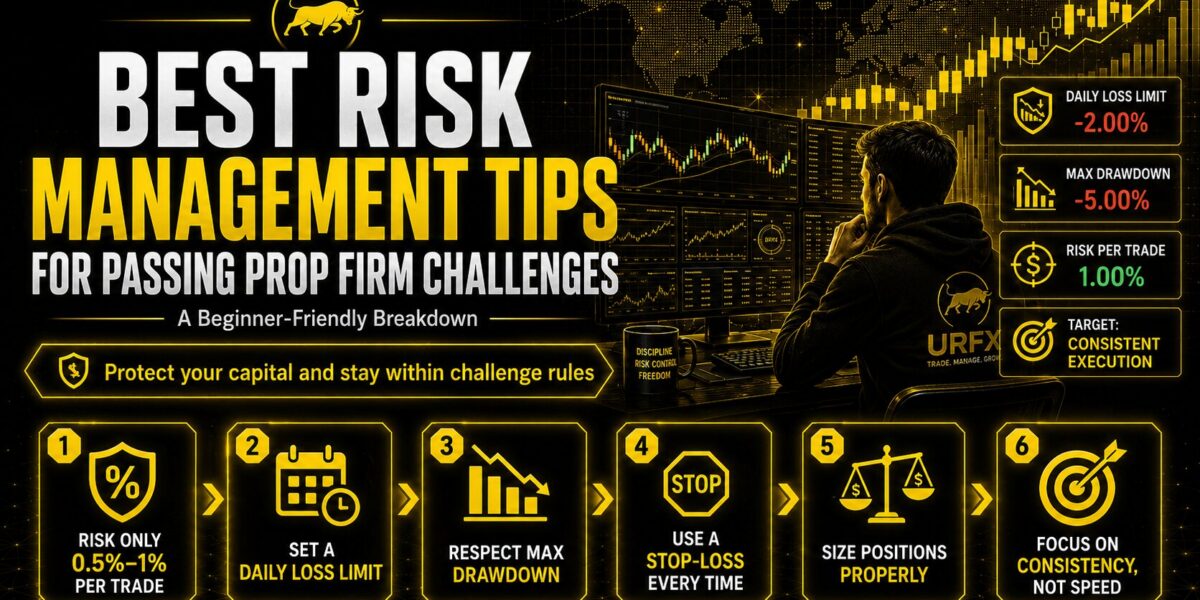
Risk Management Tips are the cornerstone of success in prop firm challenges. A Prop Firm Challenge or Prop Trading Challenge is a Prop Firm Evaluation and Evaluation Test designed to assess whether a trader deserves access to a Funded Trading Account as a Funded Trader with a Prop Trading Firm. Risk management is the primary factor that separates successful traders from those who fail their challenges. This comprehensive guide explores the best risk management tips for passing prop firm challenges, including proper position sizing based on risk per trade limits, maintaining capital preservation through daily drawdown and maximum drawdown management, establishing risk-to-reward ratio targets, implementing stop-loss discipline, developing a proven trading strategy through backtesting, creating a trading plan with clear entry and exit rules, maintaining emotional discipline to avoid overtrading in forex and prevent revenge trading, understanding challenge requirements and evaluation criteria, leveraging free retakes and bi-weekly rewards, and mastering trading psychology to maintain trading consistency under performance pressure. Whether you’re trading through a Prop Firm with Instant Funding, a Prop Firms Offering Instant Funding, or an Instant Funding Trader Program, these risk management principles apply universally. We’ll examine why reasons traders fail prop firm challenges often relate to poor risk management, how stop loss and take profit orders enforce discipline, how trading psychology impacts decision-making, and how to maintain emotional control during the evaluation phase and challenge phase .
Understanding Risk Management in Prop Firm Challenges
Risk management is the foundation of challenge success.
What Is Risk Management?
Risk management is the systematic approach to identifying, measuring, and controlling trading risk. In the context of prop firm challenges, risk management means ensuring that losses on any single trade, any single day, or throughout the entire challenge stay within predetermined limits. Risk management protects your trading capital and funded trading account from catastrophic losses .
Why Risk Management Matters
Prop firm challenges have strict drawdown limits and challenge rules that require strong trading discipline. Following effective Risk Management Tips helps traders protect their accounts and avoid unnecessary violations. Daily drawdown limits typically restrict losses to 5% of the account balance, while maximum drawdown limits often cap total losses at 10%. These Risk Management Tips also help traders control position sizes, limit exposure, and preserve capital while working toward the profit target. Traders who ignore proven Risk Management Tips can quickly breach their drawdown limits and fail the challenge.
Risk Management and Profitability
Risk management is not just about avoiding losses; it’s about achieving profitability. Proper position sizing based on risk per trade calculations ensures that winning trades generate sufficient profits to offset losses. Risk-to-reward ratio targets of 1:2 or higher ensure that average wins exceed average losses, creating trading profitability over time .
Position Sizing and Risk Per Trade
Position sizing is one of the most critical risk management decisions a trader can make. Following proven Risk Management Tips helps traders calculate the appropriate trade size based on their account balance and stop-loss level. These Risk Management Tips reduce excessive exposure and prevent a single losing trade from causing a drawdown violation. By consistently applying effective Risk Management Tips, traders can protect their capital and improve their chances of passing a prop firm challenge.
Calculating Risk Per Trade
Risk per trade is the maximum loss you’re willing to accept on any single trade, typically 1-2% of your trading capital. To calculate position sizing: (Account Balance × Risk Per Trade %) ÷ (Entry Price – Stop Loss Price) = Position Size. For example, with a $10,000 account and 2% risk per trade ($200), if your stop-loss is 50 pips away, your position size would be 4 micro lots .
Position Sizing and Account Balance
Position sizing must be recalculated as your account balance changes. After a profitable day, your trading capital increases, allowing larger position sizing. After a losing day, your trading capital decreases, requiring smaller position sizing. Traders who use fixed position sizing regardless of account balance changes often violate risk per trade limits .
Avoiding Oversized Positions
Oversized positions that exceed risk per trade limits are a primary cause of challenge failure. Traders often increase position sizing after losses in an attempt to “get even,” violating risk management rules. Capital preservation requires disciplined position sizing that never exceeds predetermined limits .
Drawdown Management and Capital Preservation
Drawdown management prevents catastrophic losses and protects traders from breaching prop firm rules. Following effective Risk Management Tips helps traders monitor daily and maximum drawdown limits before placing each trade. These Risk Management Tips encourage smaller position sizes, controlled exposure, and disciplined stop-loss placement. By consistently applying proven Risk Management Tips, traders can preserve their capital and improve their chances of completing the challenge successfully.
Understanding Drawdown Limits
Daily drawdown limits specify the maximum loss allowed within a single trading day, while overall drawdown limits define the maximum cumulative loss permitted throughout the entire challenge. Applying effective Risk Management Tips helps traders monitor both limits and avoid accidental rule violations. Maximum drawdown measures the largest peak-to-trough decline in an account balance, making these Risk Management Tips essential for controlling exposure. By consistently following proven Risk Management Tips, traders can preserve capital and improve their chances of passing the challenge.
Monitoring Your Equity Curve
Your equity curve shows how your account balance changes over time. Following practical Risk Management Tips helps you monitor this curve and identify when you are approaching your drawdown limits. For example, if your daily drawdown limit is 5% and you have already lost 4%, these Risk Management Tips suggest avoiding unnecessary trades and reducing your exposure. By consistently applying proven Risk Management Tips, you can protect your capital and prevent avoidable challenge violations.
Stop-Loss Discipline
Stop-loss orders are the primary tool for enforcing drawdown limits. Every trade must have a predetermined stop-loss level that limits your loss to your risk per trade amount. Moving stop-loss orders after entry violates challenge rules and demonstrates poor risk management .
Risk-to-Reward Ratio and Profit Targets
A strong risk-to-reward ratio ensures that potential profits exceed possible losses. Following practical Risk Management Tips helps traders choose setups where the expected reward justifies the amount of capital at risk. These Risk Management Tips prevent traders from risking too much for limited returns and support long-term consistency. By applying proven Risk Management Tips, traders can remain profitable even when some trades result in losses.
Calculating Risk-to-Reward Ratio
Risk-to-reward ratio is the ratio of your potential profit to your potential loss on a trade. A 1:2 risk-to-reward ratio means your potential profit is twice your potential loss. Calculate it as: (Take Profit Price – Entry Price) ÷ (Entry Price – Stop Loss Price) = Risk-to-Reward Ratio .
Minimum Risk-to-Reward Ratio
Most successful traders require a minimum 1:2 risk-to-reward ratio before entering a trade. This ensures that over time, even with a 50% win rate, traders achieve profitability. Entering trades with poor risk-to-reward ratios violates risk management principles .
Profit Target Achievement
Your profit target for the prop firm challenge typically requires 8-10% profit. With proper risk-to-reward ratio management, achieving your profit target becomes a mathematical certainty if you maintain trading consistency .
Trading Strategy and Backtesting
A proven trading strategy is essential for risk management success.
Developing a Proven Trading Strategy
Your trading strategy must be backtested to verify it generates positive profitability over time. Backtesting involves testing your strategy on historical price data to calculate win rate, average profit, and average loss. Only backtested strategy with documented positive profitability should be used in prop firm challenges .
Entry and Exit Rules
Your trading plan must include clear entry and exit rules. Entry criteria specify the exact conditions required to enter a trade. Exit rules specify when to take profits and when to cut losses. Clear entry and exit rules prevent impulsive trading and maintain trading consistency .
Trading System Documentation
Document your trading system in detail. Include your market analysis process, trade execution rules, stop-loss placement rules, and profit-taking rules. Having a documented trading system prevents impulsive trading and ensures trading consistency .
Emotional Discipline and Trading Psychology
Trading psychology determines challenge success.
Managing Fear and Greed
Fear and greed are the primary emotional drivers of poor risk management decisions. Fear of losing can cause traders to exit winning trades too early. Greed can cause traders to hold losing positions too long. Emotional discipline and a strong trader mindset require recognizing these emotions and following your trading plan regardless .
Avoiding Revenge Trading
Revenge trading after losses violates risk management principles. After a losing trade, traders often feel compelled to immediately enter another trade to “get even.” This revenge trading behavior typically leads to larger losses. Mental discipline requires accepting losses and waiting for the next high-probability setup .
Managing Performance Pressure
Performance pressure from profit target requirements can cause impulsive trading and poor risk management decisions. Emotional control requires maintaining your trading plan regardless of whether you’re ahead or behind on your profit target. Trading consistency and being a consistent trader comes from following your system, not from chasing profits .
Challenge Rules and Evaluation Criteria
Understanding challenge requirements ensures compliance.
Evaluation Criteria and Challenge Rules
Challenge rules specify the evaluation criteria for passing your prop firm challenge. These typically include: achieving your profit target, staying within daily drawdown and maximum drawdown limits, completing minimum trading days, and maintaining trading consistency. Understanding these challenge requirements and your trading objectives is essential .
Challenge Phase and Evaluation Phase
The challenge phase is the initial phase where you must achieve your profit target while staying within drawdown limits. The evaluation phase follows, where you must maintain profitability and trading consistency. Different prop trading firms have different challenge requirements .
Trading Restrictions and Time Limits
Some prop firm challenges have trading restrictions on which instruments you can trade or when you can trade. Some have time limits while others have no time limit. Understanding these restrictions is critical for planning your trading strategy .
Leveraging Challenge Features
Modern prop firm challenges offer features to support success.
Free Retakes and Bi-Weekly Rewards
Many prop trading firms offer free retakes if you fail your challenge, allowing you to retry without paying another challenge fee. Bi-weekly rewards provide additional motivation by paying profits every two weeks rather than waiting until challenge completion. Profit share arrangements typically provide 80-90% of profits to the trader .
Evaluation Model and Simulated Trading
Prop firm challenges use an evaluation model based on simulated trading with virtual capital in a demo environment. This allows traders to prove their ability without risking real money. Understanding that you’re trading in a demo environment with virtual capital can reduce performance pressure .
Practical Risk Management Tips
Specific tactics improve risk management execution.
Tip 1: Pre-Trade Checklist
Create a pre-trade checklist that you complete before every trade. Include: Is this trade consistent with my trading system? Does it meet my entry criteria? What is my stop-loss level? What is my profit target? What is my risk-to-reward ratio? Only enter trades that pass your checklist .
Tip 2: Daily Risk Budget
Allocate a daily risk budget equal to your daily drawdown limit. Track your daily losses against this budget. Once you’ve used 80% of your daily budget, stop trading for the day. This prevents revenge trading and enforces capital preservation .
Tip 3: Trading Journal
Maintain a trading journal documenting every trade. Record your entry reason, entry price, stop-loss level, exit price, and profit/loss. Review your journal weekly to identify patterns in your trading performance and improve your trading habits .
Tip 4: Emotional Discipline Training
Practice emotional discipline through trading psychology training. Recognize your emotional triggers and develop strategies to manage them. Meditation, breathing exercises, and pre-trade routines can improve mental discipline .
Important Disclaimer: This guide is provided for educational purposes only and does not constitute financial or investment advice. Past performance is not indicative of future results. Trading involves substantial risk, and you should only trade with capital you can afford to lose. Always consult with a qualified financial advisor before making trading decisions.