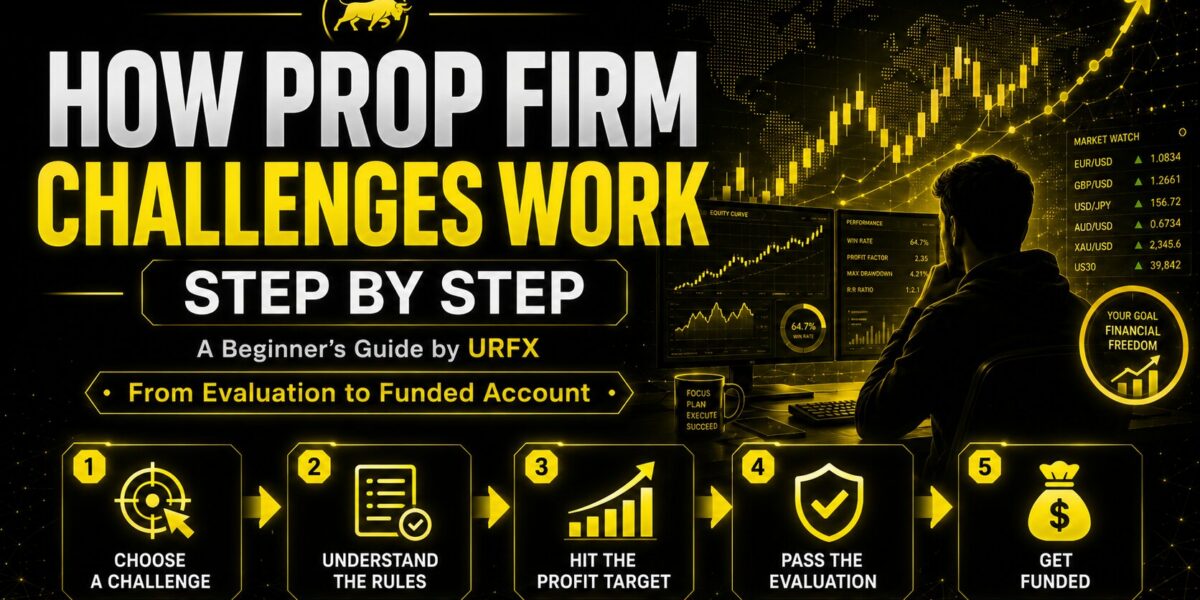
Prop Firm Challenges represent one of the most popular pathways for aspiring traders to access funded trading accounts and prove their trading skill. A Prop Trading Challenge is a structured trading challenge that allows traders to demonstrate their abilities through a simulated trading environment with No Live Trading before receiving access to real capital. Risk Warning: Challenges use virtual capital in a demo environment, not real money trading. How Prop Firm Challenges Work is a critical question for any trader considering joining a prop trading firm. This comprehensive guide explains How to Pass a Prop Firm Challenge, the different challenge models including 1-Step Challenge and 2-Step Challenge options, the Instant Funding Model and No-Challenge Model alternatives, and the specific rules and requirements that govern Prop Firm Challenge participation. Whether you’re a Beginner Prop Firm Challenge participant or an experienced trader, understanding the step-by-step process is essential for success. We’ll explore how Challenge Phase and Evaluation Phase work, the Profit Target and Daily Loss Limit requirements, the Risk Parameters and Challenge Rules that must be followed, how trading psychology impacts challenge success, how to avoid overtrading in forex during challenges, how stop loss and take profit orders enforce discipline, how lot size in forex trading affects challenge compliance, and how economic calendars help forex traders avoid major news events .
Understanding Prop Firm Challenges
Prop Firm Challenges are structured evaluation programs designed to assess a trader’s skill, discipline, and risk management before giving access to a funded account. Through Prop Firm Challenges, traders must follow specific rules such as profit targets, daily loss limits, and maximum drawdown limits. For beginners, understanding how Prop Firm Challenges work is essential before starting any evaluation program.
What Is a Prop Firm Challenge?
A Prop Trading Challenge is a trading challenge offered by a prop trading firm that allows traders to trade with virtual capital in a demo environment without risking their own money. The Prop Firm Challenge simulates real trading conditions while allowing the firm to evaluate the trader’s trading skill and risk management abilities. How Prop Firm Challenges Work is straightforward: traders must achieve a Profit Target while adhering to Loss Limit Rules and Risk Parameters over a specified period. Successful traders who Hit the Profit Target and Avoid Violating Loss Limits receive a Funded Trading Account with real capital and access to Performance-Based Rewards .
Why Traders Use Prop Firm Challenges
Beginner Prop Firm Challenge participants use challenges to prove their trading ability without risking personal capital. Experienced traders use challenges to access larger funded trading accounts and Performance Rewards than they could fund independently. How to Pass a Prop Firm Challenge successfully provides traders with Funded Account Payouts and Profit Split arrangements that reward consistent profitability .
Prop Firm Challenge vs. Instant Funding Models
Different prop trading firms offer different account models. The traditional Prop Firm Challenge requires traders to pass a Challenge Phase before receiving a Funded Account. The Instant Funding Model provides immediate access to Funded Trading Accounts without a challenge phase. The No-Challenge Model offers alternative pathways for traders who prefer to skip the challenge process. Understanding the differences between 1-Step Challenge, 2-Step Challenge, and Instant Funding Trading Firm models helps traders choose the right approach .
The Step-by-Step Challenge Process
How Prop Firm Challenges Work follows a specific sequence of phases.
Phase 1: The Challenge Phase
The Challenge Phase is the first phase of a Prop Trading Challenge. During Phase 1, traders trade with virtual capital in a demo environment to demonstrate their trading skill and Evaluation of Trading Skill. The Challenge Phase has specific requirements: traders must achieve a Profit Target (typically 8-10% of account balance), stay within Daily Loss Limit (typically 5% per day), and respect the Maximum Loss Limit (typically 10% total) and Maximum Daily Loss rules. Minimum Trading Days and Consistency Requirements must also be met. The Challenge Phase typically lasts 30-60 days, during which traders must maintain Consistent Trading and follow all Challenge Rules .
Phase 2: The Evaluation Phase
The Evaluation Phase is Phase 2 of the challenge process. During Phase 2, traders who successfully completed Phase 1 must maintain profitability and continue following Risk Parameters. The Evaluation Phase typically has slightly relaxed requirements, allowing traders to focus on Maintain Profitability rather than hitting aggressive Profit Targets. Successful completion of the Evaluation Phase results in a Funded Account with real capital .
Instant Funding vs. Challenge Models
The Instant Funding Model provides Funded Trading Accounts immediately, bypassing the Challenge Phase and Evaluation Phase. An Instant Funding Forex Prop Firm or Forex Prop Firm with Instant Funding allows traders to start with real capital immediately. The Instant Funding Trading Firm model appeals to traders who want to skip the challenge process, though it typically comes with higher fees or lower initial capital .
Challenge Rules and Risk Parameters
Challenge Rules and Risk Parameters define the boundaries of acceptable trading behavior in Prop Firm Challenges. Traders must understand these rules before starting Prop Firm Challenges, because profit targets, daily loss limits, and maximum drawdown limits all affect performance. By following the right risk parameters, traders can avoid violations and improve their chances of passing Prop Firm Challenges successfully.
Profit Target and Loss Limits
The Profit Target specifies the profit percentage required to pass the Challenge Phase. Typical Profit Targets range from 8-10% of account balance. The Daily Loss Limit specifies the maximum loss allowed in a single day, typically 5% of account balance. The Maximum Loss Limit specifies the total loss allowed during the entire challenge, typically 10% of account balance. Traders must Hit the Profit Target while Avoid Violating Loss Limits to successfully complete the challenge .
Risk Per Trade and Position Sizing
Risk Per Trade rules specify the maximum loss allowed on any single trade, typically 2-3% of account balance. Lot Size in Forex Trading must be calculated to comply with Risk Per Trade limits. Oversized positions that violate Risk Per Trade rules result in Rule Violation and potential Challenge Failure. Proper Position Sizing based on Stop Loss distance and account size is critical for compliance .
Loss Limit Rules and Violations
Loss Limit Rules are strictly enforced. Daily Loss Limit Violation occurs when daily losses exceed the specified limit, immediately ending the challenge. Maximum Loss Limit Violation occurs when cumulative losses exceed the total limit. Rule Violation of any kind can result in Challenge Failure and loss of the Challenge Fee .
Trading Discipline and Psychology
Trading Psychology and Emotional Discipline are critical for challenge success.
Avoiding Emotional Trading
Emotional Trading is the primary cause of Challenge Failure. Revenge Trading after losses violates Emotional Discipline and typically leads to Daily Loss Limit Violation. Chasing Losses and Losing Streak management require strong Trading Psychology. A Disciplined Trader follows their Rule-Based Strategy consistently, regardless of recent losses .
Avoiding Overtrading and Position Stacking
Avoid Overtrading in Forex is critical during challenges. Overtrading and Stacking Trades violate Risk Management rules and quickly consume the Daily Loss Limit. Over-Leverage and Widening Stop Losses are common mistakes that lead to Challenge Failure. Maintaining Consistent Trading with High-Quality Setups rather than Overtrading is essential .
Stop Loss and Take Profit Discipline
Stop Loss and Take Profit orders must be placed before entering trades. Stop loss and take profit discipline prevents Emotional Trading and ensures compliance with Risk Parameters. Widening Stop Losses after entry violates challenge rules and demonstrates poor Trade Discipline .
Allowed Instruments and Trading Sessions
Allowed Instruments and High-Liquidity Sessions affect trading opportunities.
Forex, Indices, Commodities, and Crypto
Most prop trading firms allow trading in Forex pairs like EURUSD and XAUUSD, Indices, Commodities, and Crypto. Low-Spread Pairs are preferred because they reduce trading costs. Account Type and Allowed Instruments vary by firm. Understanding which instruments are allowed and which have Risk Parameters restrictions is important for challenge success .
Trading Sessions and Market Conditions
High-Liquidity Sessions like the London Session, New York Session, and Overlapping Session provide better trading conditions. Asian Session trading may have wider spreads and lower liquidity. Market Conditions vary significantly between sessions, affecting the availability of high probability setups and High-Probability Setups .
News Events and Economic Calendars
Economic calendars help forex traders avoid major news events that create News Spikes and excessive volatility. Trading during News Spikes can quickly violate Daily Loss Limit rules. Low-Volume Times should also be avoided as they increase slippage and reduce High-Probability Setups .
Trading Platforms and Tools
Prop Trading Firms provide specific trading platforms and Account Monitoring Tools.
MT4, MT5, cTrader, and Match-Trader
Most prop trading firms offer MT4, MT5, or cTrader platforms. Some firms use proprietary platforms like Match-Trader. Understanding the platform’s features, order types, and Stop Loss functionality is important for compliance .
Trading Dashboard and Performance Analytics
Trading Dashboard and Performance Analytics tools help traders monitor their progress toward the Profit Target and track Daily Loss Limit usage. Account Monitoring Tools provide real-time visibility into Equity Curve development and Risk Parameters compliance .
Passing the Challenge: Key Success Factors
How to Pass a Prop Firm Challenge requires specific strategies.
Achieving the Profit Target
Hit the Profit Target by focusing on High-Probability Setups and Consistent Trading. Avoid Overtrading and Revenge Trading that consume the Daily Loss Limit without generating profits. Maintain Profitability by following your Rule-Based Strategy consistently. A High-Risk Trading Style may achieve quick profits but increases Challenge Failure risk .
Maintaining Risk Management
Risk Management and Risk Control are critical. Avoid Violating Loss Limits by respecting Daily Loss Limit and Maximum Loss Limit rules. Never exceed Risk Per Trade limits regardless of confidence in a setup. Stop Loss placement must be predetermined and respected .
Emotional Discipline and Patience
Emotional Discipline requires patience to wait for High-Probability Setups rather than Overtrading during slow periods. Trading Psychology training helps traders recognize Emotional Triggers and maintain discipline. A Disciplined Trader skips trades that don’t meet criteria, even if the account is below the Profit Target .
Rewards and Account Scaling
Successful challenge completion leads to Performance Rewards and Account Scaling.
Funded Account Payouts and Profit Split
Funded Account Payouts provide traders with a Profit Split of their earnings. Typical Profit Split arrangements are 80/20 (trader receives 80%, firm receives 20%) or 90/10. Performance-Based Rewards incentivize consistent profitability. Payment Options vary by firm and may include direct bank transfers, cryptocurrency, or other methods .
Scaling Plan and Account Growth
Account Scaling allows successful traders to increase their Funded Trading Account size over time. Scaling Plan structures typically allow traders to double their account size after achieving specific profitability milestones. Account Scaling provides access to larger Performance Rewards .
Challenge Fee Refund and Passing Reward
Some firms offer Challenge Fee Refund upon successful challenge completion. A Passing Reward bonus may be provided to traders who complete the challenge and transition to a Funded Account .
Common Challenge Mistakes
Understanding common mistakes helps traders avoid Challenge Failure.
Daily Loss Limit Violations
Daily Loss Limit Violation is the most common reason for Challenge Failure. Oversized Positions, Revenge Trading, and Chasing Losses quickly consume the Daily Loss Limit. Emotional Trading after losses leads to Daily Loss Limit Violation .
Rule Violations and Over-Leverage
Rule Violation of any kind can result in immediate Challenge Failure. Over-Leverage and Stacking Trades violate Risk Parameters. Widening Stop Losses after entry violates Loss Limit Rules .
Insufficient Risk Management
Poor Risk Management leads to Challenge Failure. Traders who don’t calculate Lot Size in Forex Trading properly or who ignore Stop Loss placement rules quickly violate loss limits .
Important Disclaimer: This guide is provided for educational purposes only and does not constitute financial or investment advice. Past performance is not indicative of future results. Trading involves substantial risk, and you should only trade with capital you can afford to lose. Always consult with a qualified financial advisor before making trading decisions.