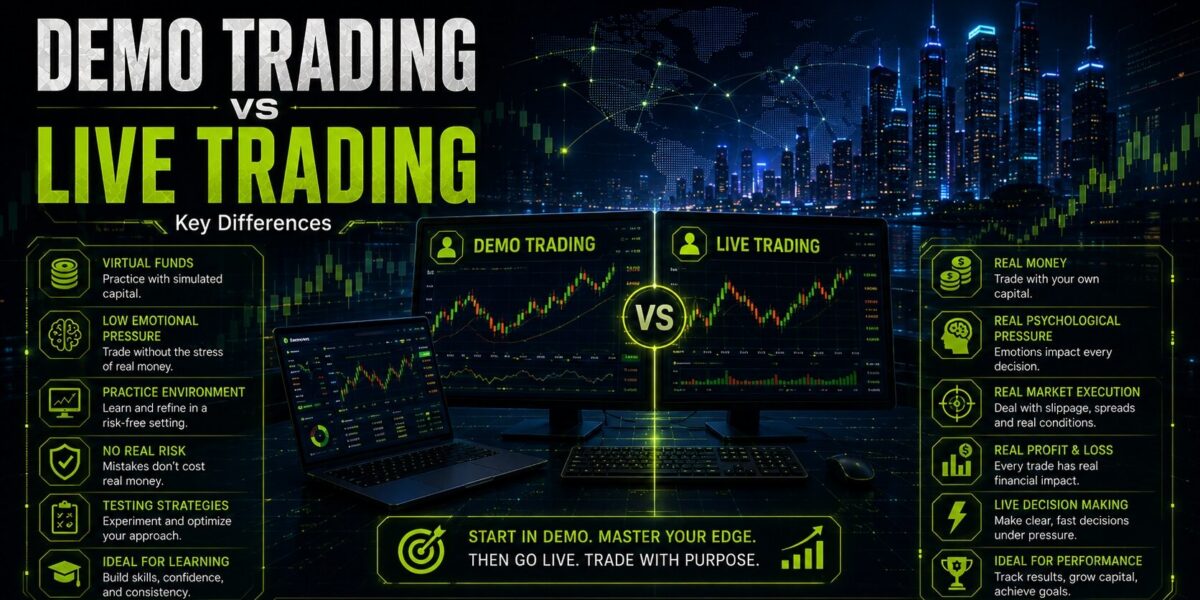
The transition from demo trading to live trading represents one of the most critical junctures in a trader’s journey. Many traders who excel in a simulated trading environment struggle dramatically when they begin trading with real money. This comprehensive guide explores the fundamental differences between Demo Trading vs Live Trading, examines the psychological and operational challenges of this transition, and provides practical strategies for successfully moving from demo trading account practice to live trading account execution. Whether you are a novice trader learning to trade or an experienced trader transitioning to financial markets through a real money account, understanding these trading challenges is essential for success. Demo Trading vs Live Trading also highlights how risk, emotions, slippage, spreads, and execution quality can affect real performance. Whether you are preparing for an Instant Funding Trading Account, an Instant Funded Account Prop Firm, or a Prop Firm Instant Funded Account, understanding Demo Trading vs Live Trading is essential for building discipline, confidence, and consistent profitability in real market conditions.
Understanding the Fundamental Differences Between Demo and Live Trading
Demo Trading vs Live Trading may appear similar on the surface, but they operate under fundamentally different conditions that dramatically impact trading outcomes. While demo accounts help traders practice strategies in a risk-free environment, live accounts introduce real money, emotional pressure, execution delays, spreads, and potential slippage. Understanding Demo Trading vs Live Trading is important because the shift from virtual funds to real capital can change how traders manage risk, make decisions, and control emotions. For anyone preparing to trade seriously, Demo Trading vs Live Trading highlights the difference between practicing in theory and performing under real market pressure.
The Simulation vs Reality: Virtual Money vs Real Money Trading : Demo Trading vs Live Trading
The most obvious difference in Demo Trading vs Live Trading is the nature of the capital at stake. In demo trading, you trade with virtual money in a controlled trading environment where losses have no real financial consequences. Your demo trading account provides an educational trading tool that allows you to practice trading strategy testing without real financial risk. However, this fundamental difference creates a psychological disconnect that cannot be fully replicated. When you are trading with real money in a live trading account, every trade carries genuine financial consequences. Understanding Demo Trading vs Live Trading is important because the shift from simulated trading results to actual outcomes can change trader behavior, confidence, risk tolerance, and decision-making processes. For serious traders, Demo Trading vs Live Trading highlights why emotional control becomes just as important as strategy when real capital is involved.
Market Conditions: Simulated vs Real
Demo trading typically occurs in a controlled trading environment where real market conditions are approximated but not perfectly replicated. Your demo account practice operates on broker data feed and price feed information, but the execution characteristics may differ significantly from live market quotes. In live trading, you experience genuine real market conditions with authentic market execution and actual price spread dynamics. The broker spread in a demo trading account may be artificially tight, while a live market spread often widens during periods of turbulent trading conditions or unpredictable market conditions. This difference in market conditions is particularly important for traders planning to join an Instant Funding Trading Account or other prop firm programs. Real-time trading in actual financial markets introduces variables that cannot be fully replicated in demo environments .
Execution Differences and Trading Costs
The mechanics of trade execution differ substantially in Demo Trading vs Live Trading, with significant implications for trading costs, profitability, and overall performance. In demo trading, orders often appear to execute quickly and smoothly because the account operates in a simulated environment. However, live trading introduces real market execution, where spreads, slippage, liquidity, order delays, and broker conditions can directly affect results. Understanding Demo Trading vs Live Trading is important because a strategy that looks profitable in a demo account may perform differently when real money and live market conditions are involved. For serious traders, Demo Trading vs Live Trading highlights why execution quality, risk control, and realistic expectations are essential for long-term success.
Trade Execution and Slippage Dynamics
Demo Trading vs Live Trading shows a clear difference when it comes to trade execution. Demo trading typically provides smooth trade execution with instant execution at your specified prices. Your orders fill immediately at the market execution price you requested, without deviation. In contrast, live trading introduces slippage—the difference between your expected trading execution price and your actual execution price. During periods with a high risk of slippage, particularly when trading less liquid pairs or during turbulent trading conditions, your actual execution price may be significantly worse than expected. Understanding Demo Trading vs Live Trading is important because execution quality can directly affect trading costs, profitability, and overall performance. For traders moving from practice to real markets, Demo Trading vs Live Trading highlights why slippage, spreads, liquidity, and order timing must be carefully considered.
Understanding Spreads and Liquidity Provider Fees
In demo trading, the price spread (the difference between bid and ask prices) is often artificially tight, sometimes even zero. Your demo trading account may not accurately reflect the broker spread you will encounter in live trading. Real live market spread dynamics include liquidity provider fees and actual market-making costs that are not fully represented in demo environments. When you back test a forex trading strategy, you must account for realistic trading costs including spreads, commissions, and slippage. Traders often discover that their profitable demo trading strategy becomes unprofitable when trading costs are factored into live trading .
Position Sizing and Market Impact
Demo trading allows you to trade any position size without concern for market impact. You can trade position sizing that would be impossible in real markets without moving prices against you. In live trading, especially when trading less liquid pairs, large position sizing can create adverse market conditions that work against your trade. This limitation is particularly relevant for traders in an Instant Funded Account Prop Firm or Prop Firm Instant Funded Account, where account rules often limit maximum position size per trade .
The Psychological Component: The Critical Difference
The most significant difference in Demo Trading vs Live Trading is not mechanical—it is psychological. For novice traders learning to trade, this psychological component often determines whether they succeed or fail in financial markets. In demo trading, decisions are usually easier because there is no real money at risk, but live trading introduces pressure, fear, greed, hesitation, and emotional reactions to losses. Understanding Demo Trading vs Live Trading is important because the same strategy can feel completely different when real capital is involved. For traders preparing to move into real markets, Demo Trading vs Live Trading highlights why discipline, emotional control, patience, and risk management are essential for long-term success.
Trading Psychology and Real Money Pressure
Trading psychology represents the fundamental divide between demo trading and live trading. In demo trading, you experience no real trading pressure because losses are not real. You can trade with perfect discipline and objectivity because there are no genuine financial consequences. However, when you transition to live trading, real trading pressure emerges immediately. Your trading behavior changes, often dramatically. Traders who maintained perfect trading discipline in demo accounts suddenly find themselves making impulsive decisions, overtrading, or underestimate trading risk in live accounts. This psychological component of trading is the primary reason why many profitable demo traders become unprofitable live traders .
Psychological Differences in Decision-Making
The psychological differences between demo trading and live trading manifest in multiple ways. In demo trading, you can objectively evaluate each trade based on your trading strategy and risk management rules. In live trading, fear and greed distort your decision-making. You might hold losing positions too long, hoping for recovery, or close winning positions too early to lock in profits. You might overtrading by taking excessive trades when you are winning, or abandon your strategy entirely after unfavorable trading results. These psychological differences are not character flaws—they are natural human responses to genuine financial risk .
Emotional Discipline and Risk Management
Developing genuine trading discipline requires experiencing real financial consequences. You cannot truly develop risk management discipline in a demo trading account because losses are not real. Only when you trading with real money do you develop the emotional fortitude necessary to follow your trading rules consistently. For traders preparing for an Instant Funding Trading Account, this emotional development is critical. Prop firms evaluate not just your profitability but your ability to maintain discipline during unfavorable trading results and turbulent trading conditions .
The Transition Challenge: From Demo to Live Trading
Successfully transitioning from demo trading to live trading requires specific strategies and realistic expectations.
Identifying and Overcoming Overconfidence
Many traders experience unfavorable trading results when transitioning to live trading because they overestimate their readiness. A trader might have achieved excellent simulated trading results in demo, generating 60% win rates and strong profitability. However, these results may not translate to live trading due to slippage, trading costs, and psychological differences in decision-making. The transition from demo trading to live trading often reveals that your strategy was less robust than your demo results suggested. To overcome this, conduct thorough back test a forex trading strategy analysis, account for realistic trading costs, and start live trading with reduced position sizing .
Gradual Position Sizing and Risk Management
Rather than immediately trading your full account size in live trading, implement a gradual transition. Start with micro-lot position sizing that represents only 1-2% account risk per trade. This approach allows you to experience real trading pressure and develop genuine trading discipline without risking significant capital. As you accumulate live account performance data and demonstrate consistent profitability, gradually increase your position sizing. This gradual approach also helps you understand how trading costs and slippage affect your actual risk to reward ratio in live conditions .
Maintaining Your Trading Strategy and Discipline
During the transition from demo to live trading, maintain strict adherence to your trading strategy and trading rules. Do not abandon your system because of a few unfavorable trading results. Remember that simulated trading results and live trading results will differ due to trading costs and slippage, but your underlying strategy remains valid. Focus on control emotions while trading forex and maintaining your trading discipline even when experiencing losses. This consistency is what separates successful traders from those who fail .
Practical Preparation for Live Trading Success
Proper preparation significantly improves your probability of success when transitioning to live trading.
Comprehensive Strategy Testing and Backtesting
Before transitioning to live trading, conduct thorough trading strategy testing using realistic assumptions. Back test a forex trading strategy using actual historical data, accounting for realistic broker spread, slippage, and trading costs. Your backtesting should reveal your expected win rate, average win size, average loss size, and maximum drawdown. Use this data to calculate your realistic risk to reward ratio and expected profitability. If your backtested results show profitability only with unrealistic assumptions about market execution or trading costs, your strategy is not ready for live trading .
Paper Trading as an Intermediate Step
Consider implementing a paper trading phase between demo trading and live trading. Paper trading uses real live market quotes and actual market conditions, but no real money is at risk. This intermediate step allows you to experience realistic trade execution and slippage while still in a risk-free trading practice environment. Paper trading reveals whether your strategy performs adequately when trading costs are realistic but real trading pressure is absent. Many traders discover critical flaws in their strategy during paper trading that would have been catastrophic in live trading .
Emotional Preparation and Mindset Development
Beyond technical preparation, develop the mental framework necessary for live trading success. Accept that unfavorable trading results will occur and that losses are part of the process. Understand that trading psychology and trading discipline are skills that must be developed through experience. Prepare yourself for the psychological differences between demo trading and live trading by mentally rehearsing difficult scenarios. For traders pursuing an Instant Funded Account Prop Firm or Prop Firm Instant Funded Account, this mental preparation is as important as technical skill development .
Avoiding Common Mistakes in the Transition
Many traders make preventable mistakes when transitioning from demo trading to live trading.
Underestimating the Impact of Trading Costs
One of the most common mistakes is underestimate trading risk by failing to account for realistic trading costs. Traders often discover that their profitable demo strategy becomes unprofitable when trading costs are included. Before transitioning to live trading, verify that your strategy remains profitable after deducting realistic broker spread, slippage, and commissions. If your risk to reward ratio is too tight, your strategy cannot survive real trading costs .
Abandoning Your Strategy After Initial Losses
Another common mistake is abandoning your trading strategy after experiencing unfavorable trading results in live trading. A few losing trades do not invalidate a strategy that was thoroughly tested. Maintain your trading discipline and continue following your trading rules consistently. Remember that simulated trading results and live trading results will differ, but this does not mean your strategy is flawed .
Failing to Control Emotions While Trading
Many traders fail to control emotions while trading forex during the transition from demo to live trading. The psychological component of real money trading overwhelms their discipline. To succeed, implement systematic approaches to forex trading mistakes prevention. Use pre-trade checklists, maintain a trading journal, and review your trading behavior regularly. These tools help you maintain trading discipline and avoid overtrading or other emotional mistakes .
Long-Term Success: Integrating Demo and Live Trading
Successful traders view demo trading and live trading as complementary rather than sequential phases. Your trading performance in live trading depends not just on technical skill but on your ability to manage the psychological demands of real money account trading.
Continuous Learning and Strategy Refinement
Even after transitioning to live trading, continue using demo trading for trading strategy testing and refinement. When you develop a new strategy or want to test modifications to your existing approach, use demo trading to validate your ideas before risking real capital. This ongoing testing trading strategy in demo prevents you from making forex trading mistakes with real money. Maintain a forex trading plan as a beginner mindset of continuous learning, regardless of your experience level. Remember that trading challenges persist regardless of experience, and continuous improvement is the hallmark of successful traders .
Monitoring Performance Across Environments
Track your live account performance and compare it to your simulated trading results. Identify areas where your live trading results differ from your expectations. Are trading costs higher than anticipated? Is slippage more severe than your backtesting assumed? Is your trading behavior different under real trading pressure? These insights allow you to refine your strategy and expectations, improving your live trading results over time .
Important Disclaimer: This guide is provided for educational purposes only and does not constitute financial or investment advice. Past performance is not indicative of future results. Trading forex and other financial instruments involves substantial risk, and you should only trade with capital you can afford to lose. Always consult with a qualified financial advisor before making trading decisions.