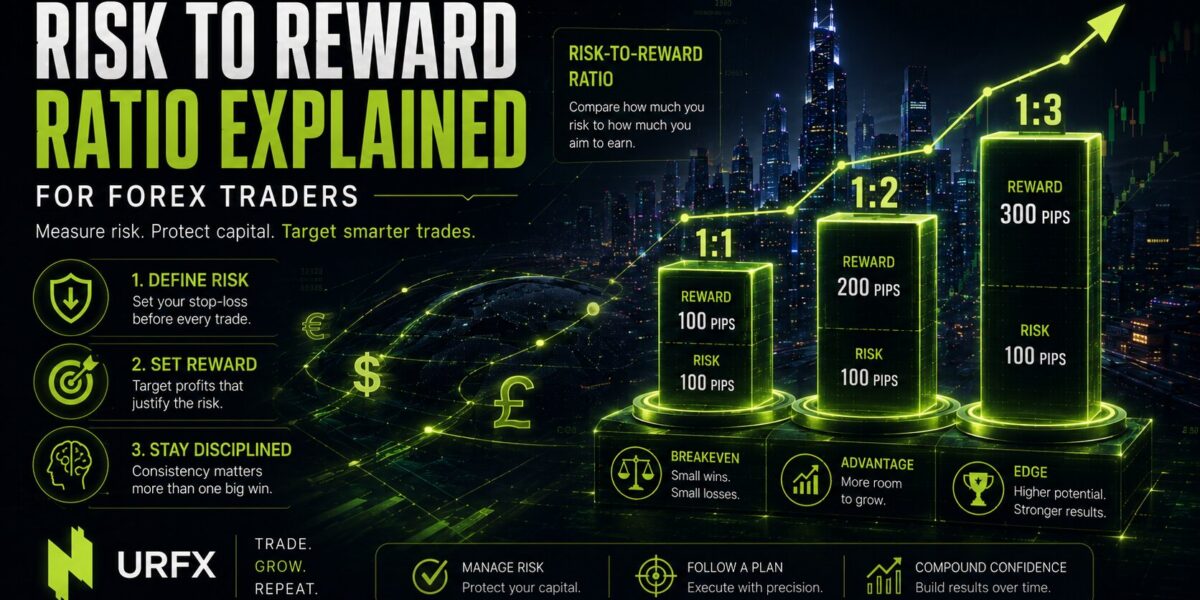
The risk-to-reward ratio, often abbreviated as R ratio or risk/reward ratio, stands as one of the most fundamental concepts in forex trading and FX trading. Yet despite its critical importance, many forex trading mistakes stem from a misunderstanding or misapplication of this principle. The Risk to Reward Ratio is not merely a mathematical calculation; it is the cornerstone of long-term profitability and the primary determinant of whether a trading strategy will succeed or fail over extended periods.
For beginner and experienced traders alike, understanding the Risk to Reward Ratio helps create a structured approach to every trade before entering the market. Instead of focusing only on potential profit, traders can clearly define how much they are willing to risk compared to how much they expect to gain.
This comprehensive guide explains the Risk to Reward Ratio in depth, demonstrating how to calculate it, apply it to your forex trading plan as a beginner, and leverage it to achieve long-term success in the forex market. By mastering this risk management tool, traders can ensure that their profitable trades consistently outpace their unsuccessful trades, creating a sustainable path to financial freedom.
Understanding the Fundamental Concept of Risk-to-Reward Ratio
The risk-to-reward ratio represents the relationship between your potential loss on a trade and your potential profit on that same trade. In its simplest form, a 1:1 risk reward ratio means you are risking $1 to potentially make $1. A 1:3 risk reward ratio means you are risking $1 to potentially make $3. A 1:5 risk reward ratio represents an even more favorable scenario where you risk $1 to make $5.
Understanding the Risk to Reward Ratio is essential for effective trading risk management and account risk protection. A well-defined Risk to Reward Ratio helps traders evaluate whether a trading opportunity is worth taking before committing capital. Rather than relying on emotions or market speculation, traders can use the Risk to Reward Ratio to make objective decisions based on potential profit versus potential loss.
By consistently applying a favorable Risk to Reward Ratio, forex traders can improve long-term profitability, reduce the impact of losing trades, and create a more disciplined trading strategy. This simple yet powerful concept serves as a foundation for sustainable growth and professional-level risk management in forex trading.
Defining Potential Loss and Potential Profit
Your potential loss on any trade is determined by the distance between your current price entry point and your stop-loss order. This distance, measured in pips gained or risked pips, represents the maximum amount of capital you will lose if the market moves against you and hits your stop-loss order.
Conversely, your potential profit is determined by the distance between your entry price and your take-profit order, measured in value in pips. The take-profit distance and stop-loss distance together form the mathematical foundation of your Risk to Reward Ratio.
By calculating these distances before entering any trading opportunity, you can ensure that every trade meets your minimum Risk to Reward Ratio threshold. A clearly defined Risk to Reward Ratio gives traders better control over risk, helps remove emotional decision-making, and supports more consistent trade planning.
When used correctly, the Risk to Reward Ratio allows forex traders to compare possible losses against potential gains before committing capital, making it an essential part of disciplined risk management.
The Role of Stop-Loss and Take-Profit Orders
A stop-loss order is your automatic circuit breaker, designed to close your position at a predetermined price target if the market moves against you. Without a stop-loss order, your potential loss is theoretically unlimited.
Conversely, a take profit order, also called a take-profit order, automatically closes your position at your predetermined reward target, locking in your potential profit before emotions can override your decision. Together, these orders define the boundaries of your risk management tool and ensure that every trade has a predetermined Risk to Reward Ratio.
A clearly planned Risk to Reward Ratio helps traders know exactly where they will exit if the trade fails and where they will take profit if the trade succeeds. This structure creates discipline, protects account capital, and reduces emotional decision-making during fast-moving forex market conditions.
Professional traders never enter a trade without both orders in place, because this is the only way to maintain consistent trading risk management. By using stop-loss and take-profit orders correctly, traders can apply the Risk to Reward Ratio with confidence and build a more controlled, repeatable trading strategy.
Calculating and Applying Risk-to-Reward Ratios
Calculating your risk-to-reward ratio is straightforward mathematics, but applying it consistently across all trading situations requires discipline and systematic execution. The calculation process differs slightly depending on your trading style, whether you are engaged in day trading, swing trading, or position trading.
A strong Risk to Reward Ratio helps traders measure whether a trade is worth taking before entering the market. Instead of focusing only on potential profit, the Risk to Reward Ratio forces you to compare your possible loss against your expected reward in a clear and structured way.
For day traders, a practical Risk to Reward Ratio may depend on fast price movement and tighter stop-loss levels. For swing traders and position traders, the Risk to Reward Ratio may involve wider stop-loss distances and larger take-profit targets. Regardless of the trading style, using this calculation consistently helps improve risk management, protect capital, and support long-term trading discipline.
Step-by-Step Calculation Process
To calculate your R:R ratio, first determine your stop-loss distance (the number of pip risked from entry to stop-loss). Next, determine your take-profit distance (the number of value in pips from entry to take profit). Finally, divide your take-profit distance by your stop-loss distance to obtain your risk-to-reward ratio. For example, if you are trading GBP/USD and your stop-loss is 50 pips away while your take-profit is 150 pips away, your risk/reward ratio is 1:3 (150 ÷ 50 = 3). This simple calculation ensures that every trading opportunity you take meets your minimum risk-reward ratio requirements. Before entering any position, verify this calculation using your charting tools, whether that is TradingView, MetaTrader 4, or another online trading platform .
Minimum Risk-to-Reward Ratios for Different Trading Styles
Different trading styles require different minimum risk-to-reward ratios to remain profitable. Day trading typically requires a higher risk-reward ratio (at least 1:2 or 1:3) because day traders experience more unsuccessful trades due to market noise and false signals. Swing trading can operate profitably with a 1:1.5 risk reward ratio because swing traders benefit from larger price movements and stronger market structure. Position trading can sometimes operate with a lower risk-reward ratio (even 1:1) because position traders hold for extended periods and benefit from major trend moves. Understanding your personal risk appetite and comfort level towards risk will help you select the appropriate minimum risk-to-reward ratio for your approach .
The Mathematical Relationship Between Win Rate and Risk-to-Reward Ratio
One of the most powerful insights in trading strategy development is understanding how your win rate and your risk-to-reward ratio interact mathematically to determine profitability. This relationship is often misunderstood by beginners, leading to forex trading mistakes that undermine long-term success.
How Lower Win Rates Can Still Generate Profits
A trader with a lower win rate, say 40%, can still achieve long-term profitability if they maintain a higher Risk to Reward Ratio. For example, a trader winning only 40% of trades but maintaining a 1:3 risk reward ratio can remain highly profitable over time because the winning trades are significantly larger than the losing trades.
Here is the mathematics: on 100 trades, 40 wins × 3 units profit = 120 units profit. Meanwhile, 60 losses × 1 unit loss = 60 units loss. Net result: 60 units profit. This shows how a strong Risk to Reward Ratio can compensate for a lower win rate and still support consistent growth.
Conversely, a trader with a higher win rate of 60% but a lower risk-reward ratio of 1:1 may produce much smaller results: 60 wins × 1 unit profit = 60 units profit, and 40 losses × 1 unit loss = 40 units loss. Net result: 20 units profit.
This mathematical reality means that successful trader status is not determined by win rate alone but by the combination of win rate and Risk to Reward Ratio. Traders who understand and apply the Risk to Reward Ratio correctly can build a more disciplined, profitable, and sustainable forex trading strategy.
The Break Even Win Rate Calculation
Your break even win rate is the minimum win rate required to remain profitable at a given risk-to-reward ratio. The formula is: Break Even Win Rate = 1 / (1 + Risk-to-Reward Ratio). For a 1:3 risk reward ratio, your break even win rate is 1 / (1 + 3) = 25%. This means you only need to win 25% of your trades to break even. For a 1:1 risk reward ratio, your break even win rate is 50%. Understanding this relationship helps traders set realistic expectations and develop a fine-tuned trading system that matches their actual win rate capabilities .
Applying Risk-to-Reward Ratios to Different Market Conditions
The optimal risk-to-reward ratio is not static; it must adapt to changing market structure, price action, and price movement patterns. Professional traders adjust their risk-to-reward ratio based on technical and fundamental analysis, market volatility, and their forex trading plan as a beginner or advanced strategy.
Technical Analysis and Market Structure
Using technical analysis to identify strong support level and resistance levels helps you set more precise stop-loss and take-profit orders. When price action clearly shows a support level near your entry point, you can place your stop-loss order very close, reducing your stop-loss distance and improving your risk-to-reward ratio. Conversely, when price movement suggests a strong resistance level far from your entry, your take-profit distance increases, further improving your risk/reward ratio. By combining technical analysis with fundamental analysis, you can identify favorable trade setups that offer higher risk-reward ratios naturally .
Adapting to Volatile Markets and Currency Pairs
Different currency pairs exhibit different volatility characteristics. GBP/USD, for example, is typically more volatile than other pairs, meaning price movements are larger and risk-to-reward ratios can be more favorable. During high-volatility periods, you may find trading opportunities with 1:5 risk reward ratios or better. Conversely, during low-volatility periods, you may need to accept lower risk-reward ratios or reduce your trading opportunity frequency. Understanding these market dynamics helps you maintain consistent trading risk management across all conditions .
Risk Management Considerations in Leveraged Trading
Forex trading typically involves leveraged trading through foreign currency contracts, which means you are controlling large positions with relatively small capital. This margin trading structure creates significant account risk and requires exceptional trading risk management discipline.
Understanding High Level of Risk and Deposit Losses
The high level of risk inherent in leveraged trading means that losses can exceed deposits in extreme market conditions. A trader with a $1,000 account using 50:1 leverage can control $50,000 in currency. A 2% adverse move in the currency pairs they are trading results in a $1,000 loss—their entire account. This reality makes risk-to-reward ratio discipline absolutely critical. By maintaining strict stop-loss discipline and ensuring every trade has a favorable risk-to-reward ratio, traders can protect their account risk even when using leverage .
Controlling Emotions While Trading Forex
The psychological pressure of leveraged trading makes it essential to control emotions while trading forex. Many traders abandon their risk-to-reward ratio discipline during emotional moments, entering trades with unfavorable ratios or holding positions beyond their take-profit order. By pre-calculating your risk-to-reward ratio before entering any trade and setting your stop-loss order and take-profit order immediately upon entry, you remove the opportunity for emotion to override your trading strategy .
Integrating Risk-to-Reward Ratios into Prop Trading Environments
For traders working with an Instant Funding Futures Prop Firm or a Futures Prop Firm with Instant Funding, understanding risk-to-reward ratios becomes even more critical. Prop firms impose strict account risk limits, and maintaining favorable risk-to-reward ratios is essential for staying funded.
Instant Funding vs Challenge Models
Whether you are trading through a No Challenge Instant Funding Prop Firm or a traditional challenge model, your risk-to-reward ratio discipline directly impacts your success. Challenge models require you to pass evaluation phases, and maintaining consistent risk-to-reward ratios helps you pass these evaluations. Instant Funding vs challenge models both benefit from traders who understand that long-term profitability comes from consistent risk-to-reward ratio application, not from occasional lucky trades .
Comparing Futures vs CFDs in Prop Trading
When deciding between futures vs cfds, consider how each instrument’s characteristics affect your ability to maintain favorable risk-to-reward ratios. Futures offer transparent volume data and centralized clearing, making it easier to calculate precise risk-to-reward ratios. CFDs offer flexibility but may have wider spreads, affecting your stop-loss distance and take-profit distance calculations. Understanding these differences helps you select the instrument that best supports your risk-to-reward ratio strategy .
Practical Implementation and Long-Term Success
Implementing risk-to-reward ratio discipline requires more than understanding the concept; it requires systematic execution and continuous monitoring. This is where many traders fail, abandoning their trading strategy when price movements create emotional pressure.
Pre-Trade Planning and Documentation
Before entering any trading opportunity, document your risk-to-reward ratio calculation. Write down your entry price, stop-loss order price, take-profit order price, and your calculated R:R ratio. This documentation serves two purposes: it forces you to verify your calculation before entry, and it creates a record for later analysis. Over time, reviewing these records helps you identify patterns in which risk-to-reward ratios produce the best results for your specific trading style and market conditions .
Avoiding Common Risk-to-Reward Mistakes
Many traders make critical mistakes when applying risk-to-reward ratios. Some traders accept lower risk-reward ratios too frequently, undermining their long-term profitability. Others become so focused on achieving high risk-to-reward ratios that they miss trading opportunities with acceptable ratios. Still others fail to maintain stop-loss discipline, allowing potential loss to exceed their calculated risk. By remaining aware of these forex trading mistakes and maintaining strict discipline, you can avoid these pitfalls and achieve long-term success .
Important Disclaimer: This guide is provided for educational purposes only and does not constitute financial advice or investment advice. Past performance is not indicative of future results. Trading forex involves substantial risk, and you should only trade with capital you can afford to lose. Always consult with a qualified financial advisor before making trading decisions.