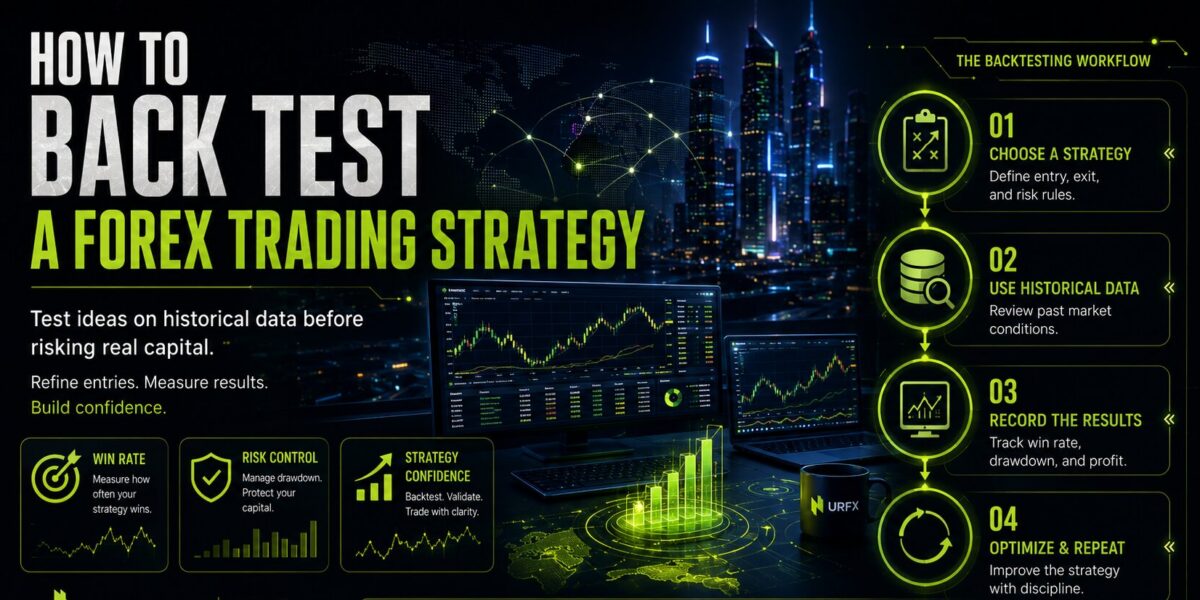
The difference between a trader who succeeds and one who fails often comes down to preparation. Backtesting is the process of testing your trading strategy against historical price data to evaluate its performance before risking real capital. Whether you trade forex trading, FX trading, or other instruments, proper trading risk management through backtesting is essential. For traders operating through a Prop Firm with Instant Funding or any Prop Firms Offering Instant Funding, backtesting is absolutely critical. This comprehensive guide explains how to properly backtest your forex trading strategy, interpret the results, and use those insights to develop a fine-tuned trading system capable of generating long-term profitability. By understanding how to backtest effectively, you can identify forex trading mistakes early, validate your risk-to-reward ratio and R:R ratio assumptions, and build the confidence necessary to execute your forex trading plan as a beginner with discipline and consistency .
Understanding the Purpose and Benefits of Backtesting
Backtesting is far more than a mathematical exercise; it is a critical risk management tool that separates professional traders from gamblers. Through forex backtesting, traders can run a simulation of their trading system against years of historical data and evaluate how the strategy may have performed under different market conditions.
When you backtest your Forex Trading Strategy, you can identify weaknesses, improve entry and exit rules, and make decisions based on data rather than emotion. Effective forex backtesting also helps measure potential profitability, drawdowns, win rates, and overall consistency before real capital is placed at risk.By reviewing past price movements and changing market conditions, every Forex Trading Strategy can be refined, optimized, and strengthened. Consistent forex backtesting gives traders greater confidence in their rules while helping them avoid untested decisions driven by fear, excitement, or short-term market noise.
Why Backtesting Matters for Long-Term Success
The primary purpose of backtesting is to answer a fundamental question: does your Forex Trading Strategy have a genuine statistical edge, or are you simply chasing random price movements? A successful trader understands that long-term success is built on strategies that have been rigorously tested and validated.
Without backtesting, you are essentially gambling with your capital and hoping that your intuition and analysis are correct. Backtesting allows you to evaluate your Forex Trading Strategy’s win rate, calculate its expected risk/reward ratio, assess the drawdown limit, and identify potential weaknesses before they cost you money.This process is especially important for anyone preparing to join a prop firm or complete a trading challenge. Most firms use an evaluation program to assess a trader’s discipline, profitability, and risk management before offering access to a larger account. A properly tested strategy can help a funded trader follow strict rules, protect capital, and improve the likelihood of maintaining long-term account eligibility.
Different firms may apply different requirements. Some offer no minimum trading days, while others use a consistency rule to prevent traders from relying on one unusually large winning trade. Many also define a specific profit split, maximum daily loss, overall drawdown, and payout structure.Popular firms such as FTMO, FundedNext, Topstep, E8 Markets, The Funded Trader, and TradeDay each have their own trading objectives and account conditions. Traders should therefore test their strategy against the exact rules of the firm they plan to use rather than relying on general performance results.
Backtesting can be completed manually or with specialist software. Platforms such as MetaTrader 4, MetaTrader 5, and cTrader allow traders to review historical price data, test entry and exit rules, and analyze performance across different currency pairs and market conditions.For traders participating in an Instant Funding Trader Program, this validation is equally important. It helps ensure that every Forex Trading Strategy is supported by reliable data before it is used in live market conditions, reducing emotional decision-making and improving overall risk control.
Identifying Strategy Weaknesses Before Live Trading
Backtesting reveals patterns that are invisible in real-time trading. You might discover that your strategy performs poorly during certain market conditions, or that it generates excessive unsuccessful trades during high-volatility periods. You might find that your stop-loss placement is too tight, causing premature exits during normal market fluctuations. Or you might discover that your take profit order targets are unrealistic given typical price movement patterns. These insights, gained through backtesting, allow you to refine your approach before risking real capital. This is particularly important for traders learning to control emotions while trading forex, as backtesting provides objective data that removes emotional decision-making from strategy evaluation .
Setting Up Your Backtesting Environment
Proper backtesting requires the right tools, reliable data, and a consistent methodology. The quality of your results depends heavily on the accuracy of your historical data and how closely the test reflects real market conditions. To evaluate a Forex Trading Strategy properly, traders should use dependable price history, realistic spreads, and clearly defined entry and exit criteria.
A poorly tested Forex Trading Strategy can create false confidence and lead to costly mistakes when live capital is involved. This becomes especially important in prop trading, where traders must follow strict account conditions and demonstrate discipline from the beginning. With the right process, every Forex Trading Strategy can be reviewed more accurately, improved consistently, and prepared for controlled execution.
Selecting Appropriate Charting Tools and Data Sources
The most popular charting tools for backtesting are TradingView and MetaTrader 4, both of which provide historical data and useful testing capabilities. TradingView offers a user-friendly interface and extensive data for currency pairs such as GBP/USD and other major markets, making it easier to review how a Forex Trading Strategy performs under different conditions.
MetaTrader 4 provides more advanced testing features and supports automated testing through Expert Advisors. Regardless of the platform you choose, your historical data should be accurate and cover a sufficient period, ideally at least three to five years. This helps capture trending markets, consolidations, high-volatility periods, and changing economic conditions.
The quality of the data directly affects the reliability of your results. Traders preparing for an evaluation program or trading challenge should also make sure the testing environment reflects the spreads, commissions, leverage, and execution conditions they are likely to face.
Defining Your Trading Parameters and Risk Management Rules
Before beginning any backtest, clearly define all parameters of your Forex Trading Strategy. This includes your entry and exit points, stop-loss distance measured in pip risked, take-profit distance measured in pips gained, value in pips, and your preferred risk-to-reward targets.
You may test specific structures such as a 1:1 risk reward ratio, 1:3 risk reward ratio, or 1:5 risk reward ratio. You should also define your price target, reward target, position size, and maximum account exposure per trade.
Clear trading rules are essential because they prevent you from changing decisions after seeing how the market moved. Your risk management framework should also specify daily loss limits, maximum overall exposure, and how much capital you are willing to risk on each setup.
Traders should document whether the strategy is based on technical analysis, fundamental analysis, or a combination of both. The chosen trading style should also be clear, whether it involves day trading, swing trading, or position trading.
Additional factors may include your personal risk appetite, comfort level toward risk, preferred trading sessions, and the financial products you intend to trade. These details make the test more realistic and help ensure that the results reflect how the strategy would actually be used.
Conducting Your Backtest: Methodology and Best Practices
The backtesting process requires discipline and attention to detail. Small errors in the methodology can produce misleading results and lead to poor decisions. Every setup should be recorded consistently, and the original conditions should be followed without emotional adjustment.Avoid changing your Forex Trading Strategy midway through the test simply because several losing trades appear. Doing so introduces hindsight bias and makes the final results unreliable. Any changes should be documented and tested separately as a new version of the strategy.
A structured approach is particularly important for traders who must comply with a drawdown limit or consistency rule. These conditions can affect how aggressively a strategy can be traded, even when the overall results appear profitable.Traders should also assess whether the strategy can support a realistic profit split and whether it remains effective under different account conditions. Firms offering no minimum trading days may provide greater flexibility, but the strategy must still be tested for sustainable performance rather than short-term gains.
Manual vs Automated Backtesting
Manual backtesting involves reviewing historical charts and identifying trades that would have met your predefined criteria. The trader records the entry price, exit price, stop loss, take profit, and final profit or loss for each setup.
This method is time-consuming, but it provides deeper insight into how a strategy behaves. It allows traders to observe market structure, price action, volatility, and the context surrounding each trade.Automated backtesting uses software to apply the strategy to historical data. It is faster, supports a larger number of trades, and reduces human error in trade identification. However, automated results are only reliable when the strategy is coded accurately and the assumptions reflect realistic conditions.
For many traders, a combination of both methods is the most effective approach. Automated testing can be used for speed and scale, while manual review can help explain why the strategy performed differently during certain periods.A scaling plan should also be considered during testing. Rather than increasing position size too quickly, traders can test how the strategy performs as account equity grows and risk gradually increases. This creates a more realistic view of long-term performance and helps traders prepare for larger funded accounts.
Accounting for Transaction Costs and Slippage
One of the most common backtesting mistakes is ignoring transaction costs and slippage. In real trading, you pay broker commissions and spreads, and your take-profit order and stop-loss order may not execute at exactly the price you specified. When backtesting, reduce your potential profit by an amount equivalent to your typical spread and commission costs. For leveraged trading through foreign currency contracts, this adjustment is particularly important. Many traders are shocked to discover that their seemingly profitable strategy actually generates losses when real-world trading costs are factored in .
Testing Across Multiple Market Conditions
A robust trading strategy must perform reasonably well across different market conditions. Test your strategy during trending markets, ranging markets, high-volatility periods, and low-volatility periods. Test during periods of high level of risk and market stress, as well as during calm, orderly market conditions. If your strategy only works in one specific market environment, it is not reliable for long-term profitability. A fine-tuned trading system should demonstrate consistent profitability across diverse market conditions, even if the absolute returns vary .
Analyzing Backtesting Results and Key Performance Metrics
Once you have completed your backtest, the real work begins: interpreting the results and extracting actionable insights.
Understanding Win Rate, Profit Factor, and Drawdown
Your win rate is the percentage of trades that generate profit. However, win rate alone is misleading—a 30% win rate can be highly profitable if your risk-to-reward ratio is favorable with higher risk-reward ratio targets. Conversely, even a lower risk-reward ratio can work if your higher win rate is sufficiently high. The profit factor is the ratio of gross profit to gross loss. A profit factor above 1.5 is generally considered good; above 2.0 is excellent. Maximum drawdown is the largest peak-to-trough decline in your account equity during the backtest period. Understanding your maximum drawdown helps you prepare psychologically for the inevitable losing streaks and ensures that your account risk management is appropriate .
Calculating Expected Value and Risk-to-Reward Metrics
Your expected value per trade is calculated as: (Win Rate × Average Win) – (Loss Rate × Average Loss). This calculation tells you how much you expect to make or lose on each trade, on average. For example, if your win rate is 40%, your average win is $300, your loss rate is 60%, and your average loss is $150, your expected value is (0.40 × $300) – (0.60 × $150) = $120 – $90 = $30 per trade. This positive expected value indicates a profitable strategy. Verify that your backtested risk-to-reward ratio aligns with your expectations and that your strategy generates positive expected value. A favorable trade setup will show positive expected value across your entire backtest period .
Identifying Equity Curve Patterns and Consistency
Examine your equity curve (the line showing your account balance over time) for patterns. Does your strategy generate consistent, steady growth, or does it experience large swings? A smooth equity curve suggests a fine-tuned trading system with consistent profitability. Large swings suggest high volatility in returns, which may indicate excessive account risk per trade or a strategy that is overly sensitive to market conditions. Consistent profitability across the entire backtest period is more reliable than a strategy that generates large profits during one period but losses during another .
Avoiding Common Backtesting Pitfalls
Even experienced traders make forex backtesting mistakes that can lead to false conclusions about strategy performance. Inaccurate historical data, unrealistic spreads, and changing the rules midway through a test can all distort forex backtesting results. A disciplined forex backtesting process should follow consistent rules, realistic market conditions, and a sufficiently large sample of trades.
Overfitting and Curve Fitting
Overfitting occurs when you optimize your strategy parameters so extensively that it fits the historical data perfectly but fails in live trading. You might adjust your stop-loss distance or take-profit distance repeatedly until your backtest shows perfect results. However, these optimized parameters may not work in future market conditions. To avoid overfitting, test your strategy across multiple time periods and market conditions, including different market structure patterns and price action scenarios. If your strategy only works with very specific parameter values, it is likely overfit and will fail in live trading .
Ignoring Slippage and Real-World Trading Costs
As mentioned earlier, ignoring slippage and trading costs is a critical forex backtesting mistake. Your results may show much higher profitability than live trading if spreads, commissions, and execution delays are not included in the test.
A realistic forex backtesting process should reduce projected profits to account for average spreads, broker commissions, slippage, and other transaction costs. These expenses can significantly affect performance, especially for strategies that place frequent trades or target small price movements.You should also consider the additional risks associated with margin and leveraged trading. In extreme market conditions, losses may exceed the original deposit, so forex backtesting should include conservative position sizing, realistic leverage assumptions, and stress testing for sharp price movements.
Insufficient Historical Data and Survivorship Bias
Testing your strategy on only one or two years of data is usually insufficient for reliable forex backtesting. You should use at least three to five years of historical data, and ideally ten years or more, to capture different market cycles, volatility levels, economic events, and trading conditions.
A strong forex backtesting process should also account for survivorship bias. Testing only currency pairs that are currently active may exclude instruments that became illiquid, were restructured, or are no longer widely traded, which can make the results appear more reliable than they truly are.To improve accuracy, perform forex backtesting across a representative sample of major, minor, and suitable cross-currency pairs. This helps confirm whether the strategy is genuinely robust or only performs well on a limited set of markets.
Validating Your Strategy and Preparing for Live Trading
After completing your forex backtesting process and avoiding common mistakes, you must validate the findings before deploying real capital. Reliable forex backtesting results should be confirmed through forward testing, out-of-sample data, and realistic trading conditions that include spreads, commissions, and slippage. This final validation helps ensure that your forex backtesting conclusions are consistent, practical, and not simply the result of overfitting historical market data.
Paper Trading and Demo Account Testing
Before trading with real capital, conduct paper trading (simulated trading with no real money) or demo account testing using your online trading platform. This allows you to test your strategy in real-time market conditions without financial risk. Paper trading often reveals issues that backtesting missed, such as difficulty in identifying entry signals in real-time or emotional challenges in executing your strategy during volatile markets. For traders planning to join a Prop Firm with Instant Funding or Prop Firms Offering Instant Funding, paper trading is an excellent preparation method .
Establishing Risk Management Rules for Live Trading
Your forex backtesting results should directly inform your risk management settings for live trading. If the test shows a maximum drawdown of 15%, your stop-loss and position-sizing rules should be designed to prevent losses from exceeding that level under normal market conditions.
When forex backtesting reveals a lower win rate than expected, adjust your account risk per trade accordingly. You should also calculate your break-even win rate based on your risk-to-reward ratio so you understand the minimum level of performance required to remain profitable.Document every trading rule and commit to following it strictly, regardless of market conditions or recent results. This discipline helps translate forex backtesting insights into consistent execution and is essential for long-term trading success.
Understanding Past Performance and Future Results Disclaimer
Remember that past performance is not indicative of future results. Markets evolve, volatility changes, and new factors emerge that were not present during your backtest period. Your backtest provides evidence that your strategy had an edge in the past, but it does not guarantee future profitability. Maintain realistic expectations and be prepared to adapt your strategy as market conditions change. This is particularly important for traders in an Instant Funding Trader Program, where consistent performance is required to maintain funding .
Integrating Backtesting into Your Trading Journey
For traders learning to control emotions while trading forex and avoid forex trading mistakes, backtesting provides objective validation that removes emotion from strategy evaluation. By understanding how to properly backtest, you can build confidence in your forex trading plan as a beginner and develop the discipline necessary for consistent execution.
Comparing Strategy Performance Across Instruments
Consider testing your strategy across different instruments to understand its robustness. Test on GBP/USD and other major currency pairs, as well as on different asset classes if you plan to trade futures vs cfds. A strategy that works consistently across multiple instruments is more likely to generate long-term profitability than one that only works on a single pair. Look for profitable trades that show consistent patterns and identify trading opportunity characteristics that lead to success. Analyze how your strategy performs at different support level zones and current price levels. This diversification also helps you identify whether your strategy has a genuine edge or whether it simply works well on one specific instrument .
Continuous Improvement and Strategy Refinement
Backtesting is not a one-time event; it is an ongoing process. As you accumulate live trading results, compare them to your backtested expectations. If your live results differ significantly from your backtest, investigate why. Did market conditions change? Did you fail to follow your trading rules consistently? Did you make forex trading mistakes in execution? Use these insights to refine your strategy and conduct new backtests. Track your potential loss and potential profit on each trade, measured in risked pips and value in pips, to ensure they align with your backtested assumptions and your risk to reward ratio expectations. Over time, this iterative process produces increasingly robust and profitable trading systems .
Frequently Asked Questions
1. What is forex backtesting?
Forex backtesting is the process of testing a Forex trading strategy using historical market data to evaluate how it would have performed in the past. It helps traders identify strengths, weaknesses, win rates, drawdowns, and overall profitability before risking real capital.
2. How many years of historical data should I use for backtesting?
For reliable results, it is recommended to use at least 3–5 years of historical data. Ideally, testing over 10 or more years allows your strategy to experience different market cycles, volatility levels, and economic conditions, making the results more dependable.
3. Which platform is best for forex backtesting?
Popular platforms for forex backtesting include MetaTrader 4 (MT4), MetaTrader 5 (MT5), TradingView, and cTrader. MT4 and MT5 are widely used for automated strategy testing, while TradingView is excellent for manual chart analysis and historical replay.
4. Why should trading costs be included in backtesting?
Ignoring spreads, commissions, slippage, and other trading costs can produce unrealistic results. Including these costs provides a more accurate picture of how your Forex trading strategy is likely to perform in live market conditions and helps avoid overly optimistic expectations.
5. Is backtesting enough before trading with real money?
No. Backtesting should be followed by forward testing on a demo account or a simulated environment. Combining historical testing with forward testing helps confirm that your strategy performs consistently under current market conditions before you risk real capital or participate in a prop firm evaluation.