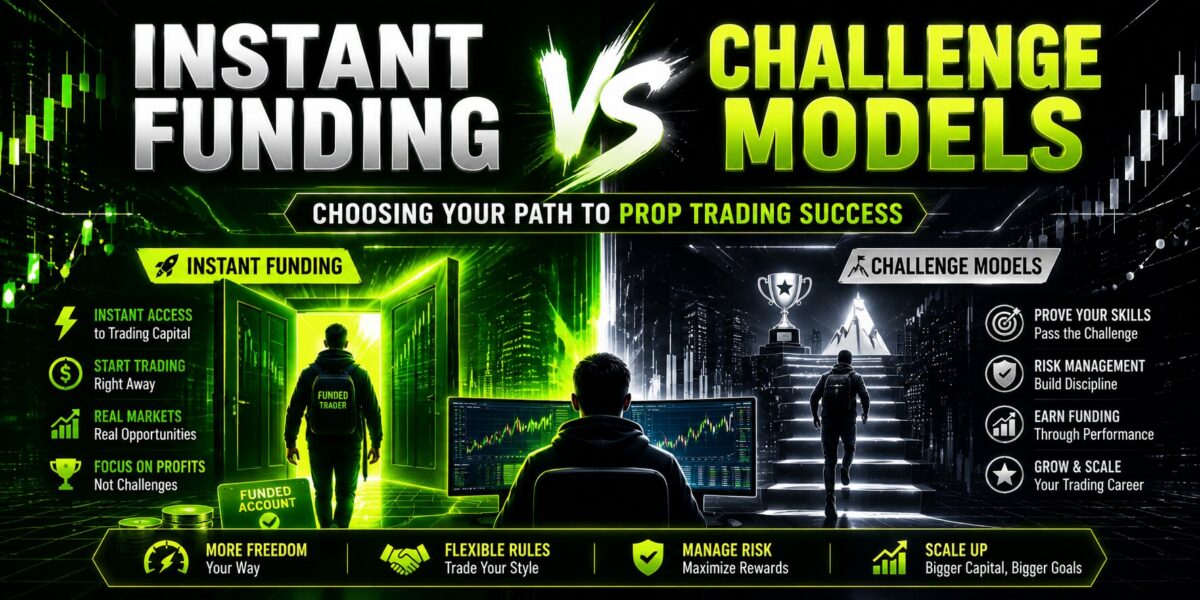
The landscape of proprietary trading has transformed dramatically over the past few years, offering traders multiple pathways to access substantial trading capital. Two dominant models have emerged as the primary options for aspiring traders seeking to join an instant prop funding firm: instant funding and challenge-based models. Understanding the distinctions between these approaches is crucial for making an informed decision that aligns with your trading objectives and personal circumstances.
The Instant Funding vs Challenge Models debate continues to shape the modern prop trading industry, as both approaches offer unique paths for traders seeking funded accounts. The instant funding model provides immediate access to capital, allowing traders to begin their journey without undergoing a rigorous evaluation process. Conversely, the challenge models require traders to demonstrate their proficiency through a structured evaluation phase before gaining access to funded trading accounts.
Each approach carries distinct advantages and considerations that warrant careful examination. Understanding Instant Funding vs Challenge Models is essential for traders who want to align their funding choice with their trading psychology, risk tolerance, and long-term goals. While instant funding prioritises speed and accessibility, challenge-based funding often focuses on discipline, consistency, and performance validation. Choosing between Instant Funding vs Challenge Models ultimately depends on a trader’s experience level, confidence, and preferred trading strategy.
Understanding Instant Funding Models
What Is Instant Funding?
Instant funding represents a revolutionary approach in the prop trading industry, eliminating the traditional barriers to entry that have long characterized proprietary trading firms. With this model, traders receive immediate access to trading capital upon account creation, bypassing the need for an evaluation period. This streamlined approach has democratized access to substantial trading resources, making professional forex trading more accessible to a broader audience while helping traders scale their strategies faster.
The instant prop funding firm model operates on the premise that experienced traders should not be delayed by lengthy evaluation processes. Instead of waiting weeks or months to prove their trading acumen, traders can begin executing their trading strategy immediately. This immediacy appeals particularly to traders who have already developed robust trading systems and psychological discipline through years of experience or extensive backtesting.
How Instant Funding Works : Instant Funding vs Challenge Models
When you join an instant funding program, the onboarding process is remarkably straightforward. After completing basic registration and account setup, you gain immediate access to your funded trading account with a predetermined trading capital allocation. There are no intermediate steps, no simulated trading phases, and no performance thresholds to overcome before commencing live trading.
The trading conditions in instant funding accounts typically mirror those of the firm’s standard offerings, including specific risk management parameters such as daily loss limits, maximum loss limits, and trailing drawdown restrictions. These rules ensure that traders maintain discipline while protecting the firm’s capital. Despite the speed of funding, the trading rules remain stringent and professionally structured.
Advantages of Instant Funding
One of the biggest advantages highlighted in Instant Funding vs Challenge Models is the elimination of waiting periods through instant funding programs. Traders with proven track records can immediately deploy their capital and begin generating returns without spending weeks or months completing evaluation stages.
This model also appeals to traders who have already validated their strategies through extensive backtesting or personal trading experience, as they need not repeat this validation process through a firm’s evaluation protocol. In the broader discussion of Instant Funding vs Challenge Models, instant funding is often viewed as the faster and more flexible option for experienced traders seeking immediate market exposure. Many traders prefer Instant Funding vs Challenge Models comparisons because they help determine whether speed, accessibility, or structured skill verification better aligns with their trading goals and risk management approach.
Additionally, instant funding reduces psychological pressure, which is one of the key advantages often discussed in Instant Funding vs Challenge Models comparisons. Many traders find that the evaluation phase of challenge models introduces artificial stress that doesn’t reflect real trading conditions.
By bypassing this phase, instant funding allows traders to operate in their natural trading environment from day one, potentially leading to more authentic performance metrics and better trading outcomes. In many Instant Funding vs Challenge Models discussions, traders highlight how instant funding supports confidence, emotional stability, and faster decision-making under live market conditions. Understanding the psychological differences in Instant Funding vs Challenge Models can help traders choose a funding path that better suits their mindset, trading habits, and long-term consistency.
The financial efficiency of instant funding cannot be overlooked. Traders avoid the costs associated with extended evaluation periods and can begin generating profit split returns immediately. For traders operating with limited time availability, this accelerated path to profitability is particularly valuable.
Exploring Challenge-Based Models
What Are Challenge Models?
Challenge models represent the traditional approach to prop trading, wherein traders must successfully complete a structured evaluation phase before gaining access to funded trading accounts. These models include variations such as one-step challenges, two-step challenges, and specialized offerings like Stellar Lite challenges. Each iteration maintains the fundamental principle: demonstrate competence before receiving capital.
The challenge phase typically involves trading with simulated funds under conditions that closely mirror live market environments. Traders must achieve specific profit targets while adhering to strict risk management rules. Only after successfully completing these objectives do traders gain access to the firm’s actual trading capital.
Within the broader comparison of Instant Funding vs Challenge Models, challenge-based funding is often preferred by firms seeking disciplined and consistent traders who can perform under structured conditions. Many traders researching Instant Funding vs Challenge Models appreciate how challenge models encourage patience, emotional control, and long-term trading discipline before accessing larger capital allocations. Understanding the structure behind Instant Funding vs Challenge Models helps traders decide whether they prefer immediate access to capital or a performance-based pathway to funded trading success.
How Challenge Models Work
The challenge-based funding process begins with traders purchasing access to a challenge account, which provides simulated trading capital. During the evaluation period, traders execute their trading strategy under predetermined conditions. The firm monitors trading performance metrics, including consistency, adherence to risk protocols, and achievement of profitability goals.
Challenge models typically feature multiple phases. A one-step challenge requires traders to meet profit targets and maintain compliance with drawdown limits in a single phase. A two-step challenge introduces an additional verification phase, providing an extra layer of confirmation that the trader’s success was not merely fortuitous. Upon completion, traders graduate to funded trading accounts with access to the firm’s capital.
Advantages of Challenge Models
Challenge models offer several compelling advantages. First, they provide a comprehensive evaluation mechanism that protects the firm’s capital by ensuring that only traders demonstrating genuine proficiency receive funding. This rigorous vetting process creates a higher quality trader pool, potentially resulting in better long-term outcomes for both traders and firms.
Second, the challenge phase serves as an invaluable training ground. Traders can refine their strategies, test their trading psychology, and validate their approaches without risking personal capital. This low-stakes environment encourages experimentation and learning, ultimately producing more disciplined and skilled traders.
Third, challenge models democratize opportunity. A trader with limited personal capital can prove their worth through the challenge, gaining access to resources that would otherwise remain unavailable. This meritocratic approach has enabled countless talented traders to launch professional careers.
Comparing Key Differences
Capital Access and Timeline
The most obvious distinction between instant funding and challenge models lies in the timeline for capital access. Instant funding provides immediate access, whereas challenge models require completion of an evaluation phase that typically spans several weeks to months. For traders prioritizing speed, instant funding is clearly advantageous. However, for traders seeking a structured validation process, the challenge model’s extended timeline may feel appropriate and necessary.
Evaluation Requirements
Instant funding eliminates formal evaluation requirements, trusting in traders’ prior experience and credentials. Challenge models, conversely, mandate demonstrated performance within the firm’s specific framework. This difference reflects divergent philosophies: instant funding assumes traders know their capabilities, while challenge models require proof within a standardized context.
Cost Implications
Instant funding typically involves higher initial costs, as traders must pay for immediate capital access. Challenge models generally require lower upfront investments, with traders paying for the challenge itself rather than for capital access. However, traders must consider the opportunity cost of delayed capital access when evaluating total financial impact.
Risk Management Rules
Both models implement risk management protocols, but their application differs. Instant funding accounts often feature more generous parameters, reflecting the assumption that funded traders have already proven their competence. Challenge models typically enforce stricter rules during the evaluation phase, gradually relaxing restrictions as traders demonstrate consistency.
In the wider comparison of Instant Funding vs Challenge Models, risk management remains one of the most important factors traders evaluate before choosing a funding path. Many traders analysing Instant Funding vs Challenge Models notice that instant funding offers greater flexibility, while challenge-based programs prioritise structured discipline and controlled progression. Understanding the risk framework behind Instant Funding vs Challenge Models helps traders select an approach that matches their trading behaviour, emotional control, and long-term profitability goals.
Evaluating Your Trading Style
Scalping and Day Trading Considerations
Traders employing scalping strategies or intensive day trading approaches may find instant funding particularly appealing. These high-frequency trading styles benefit from immediate capital access and the ability to capitalize on market opportunities without delay. The reduced latency between strategy conception and execution can be significant for these traders.
Conversely, traders using swing trading or longer-term approaches may find challenge models equally suitable, as the extended timeline for capital access is less critical to their overall strategy.
News Trading and Expert Advisors
Traders utilizing news trading strategies or expert advisors (EAs) for automated execution may prefer instant funding to avoid delays in deploying their systems. However, traders using copy trading or other collaborative approaches might benefit from the structured validation that challenge models provide.
In many discussions surrounding Instant Funding vs Challenge Models, traders often evaluate how each funding structure supports their preferred trading methods and automation tools. Experienced traders comparing Instant Funding vs Challenge Models may choose instant funding for speed and flexibility, while others may value the credibility and performance verification offered through challenge-based programs. Understanding the strategic differences in Instant Funding vs Challenge Models can help traders align their funding choice with their execution style, technology usage, and overall trading objectives.
Trading Psychology and Confidence
Your personal trading psychology should influence your choice. If you possess unwavering confidence in your strategy and psychological discipline, instant funding allows you to bypass unnecessary validation. If you benefit from structured progression and milestone achievement, challenge models provide psychological scaffolding that supports your development.
Profit Structures and Payouts
Understanding Profit Splits
Both instant funding and challenge models typically employ profit split arrangements, wherein traders and firms share profits according to predetermined percentages. However, the specifics vary significantly between models and firms.
Instant funding accounts often feature competitive profit split percentages, recognizing that funded traders have already demonstrated competence. Challenge models may offer different profit-sharing arrangements, sometimes providing enhanced splits upon graduation from the challenge phase.
Payout Frequency and Reliability
Fast payouts represent a critical consideration for professional traders. Most reputable firms, whether offering instant funding or challenge models, provide regular payout structures with monthly or bi-weekly distributions. However, the specific payout schedules and minimum thresholds vary. Traders should carefully review these terms when evaluating firms.
Selecting the Right Model for Your Needs
Assessing Your Experience Level
Instant funding suits traders with substantial prior experience, whether through years of personal trading, extensive backtesting, or successful trading in other contexts. Challenge models benefit traders seeking structured validation or those with limited prior experience who wish to develop their skills within a supportive framework.
Considering Your Financial Situation
Traders with limited personal capital may prefer challenge models, which typically require lower upfront investments. Traders with available capital seeking rapid deployment might favor instant funding, accepting higher initial costs for faster access to trading opportunities.
Evaluating Your Trading Objectives
Your specific profitability goals and trading objectives should guide your choice. If your primary goal is rapid capital deployment and profit generation, instant funding aligns better with your priorities. If your focus is on long-term skill development and sustainable trading success, challenge models provide a more comprehensive framework.
Conclusion
The choice between instant funding and challenge models represents a fundamental decision in your prop trading journey. Instant funding offers speed, reduced psychological pressure, and immediate capital access for experienced traders. Challenge models provide structured validation, skill development opportunities, and lower initial costs for traders seeking comprehensive evaluation frameworks.
Neither model is universally superior; instead, each serves different trader profiles and objectives. By carefully assessing your experience level, financial situation, trading style, and personal preferences, you can select the model that best supports your path to sustainable, profitable trading within an instant prop funding firm or traditional challenge-based structure.
The most important consideration is selecting a reputable firm, regardless of funding model, that maintains transparent trading conditions, reliable payout structures, and genuine commitment to trader success. With this foundation, either pathway can lead to rewarding professional trading careers.