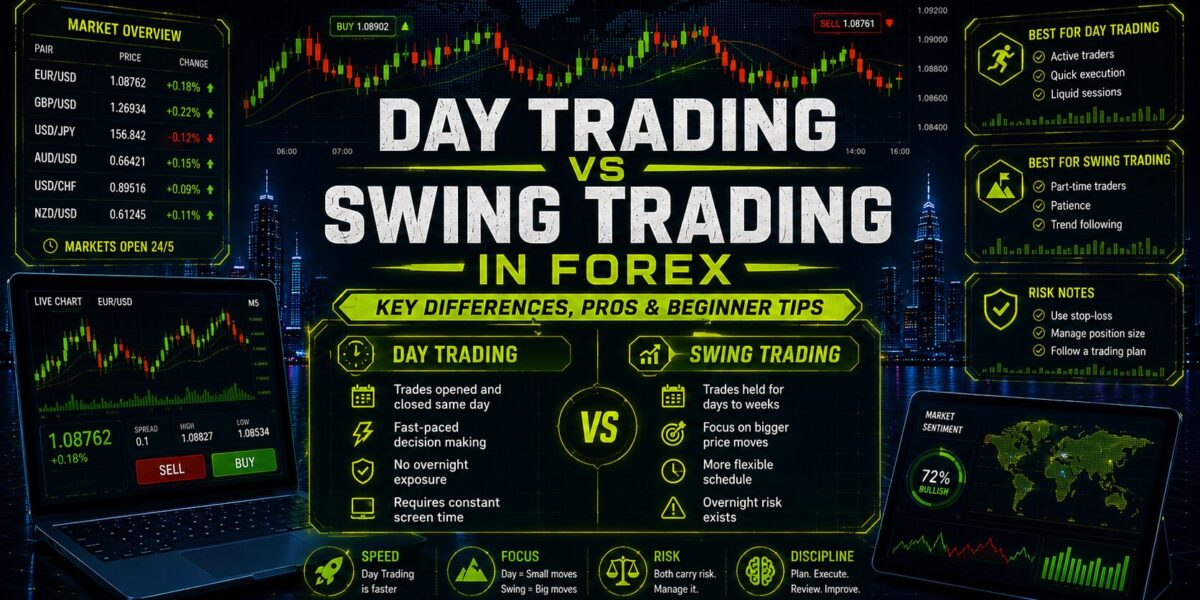
Day Trading vs Swing Trading represents one of the most fundamental decisions active market participants must make when developing effective trading strategies. Day trading involves executing multiple daily trades, with positions typically held for minutes to hours, while swing trading involves several weekly trades held for days or even weeks. Although both approaches operate within short-term trading frameworks focused on capturing price movements, Day Trading vs Swing Trading differs significantly in trade duration, trading frequency, risk tolerance, capital requirements, and the level of market attention required.
Understanding Day Trading vs Swing Trading also helps traders choose an approach that better aligns with their experience, available time, emotional discipline, financial goals, and preferred trading lifestyle. Understanding the distinctions between day trading vs swing trading is essential for traders developing their trading strategies and determining which approach aligns with their trading preferences, investment capital, and full-time commitment capacity. Whether you are evaluating an Instant Funding Futures Prop Firm, trading through a Futures Prop Firm with Instant Funding, or accessing a No Challenge Instant Funding Prop Firm,
understanding day trading vs swing trading is crucial. This comprehensive guide compares these two approaches, explores how scalping in forex differs from both, explains how breakout trading strategy and support and resistance in forex trading apply to each, and shows how to use forex candlestick charts and demo trading vs live trading to prepare for either approach .
Understanding Day Trading and Swing Trading Fundamentals
Day Trading vs Swing Trading represents two distinct short-term trading approaches with fundamentally different characteristics. Understanding Day Trading vs Swing Trading helps traders compare trade duration, frequency, risk exposure, and time commitment. Ultimately, Day Trading vs Swing Trading depends on personal goals, market experience, and preferred trading lifestyle.
What Is Day Trading?
Day trading is an active trading strategy where traders execute multiple daily trades and close all open positions before the end-of-day position closure, typically before the market closes. Day trading focuses on capturing small profits from short-term price movements that occur within a single trading day. Fundamental analysis and technical analysis both inform day trading decisions, though technical analysis dominates short-term approaches.
Day trading creates significant trading opportunities but also substantial trading losses for unprepared traders. Day traders operate in a fast-paced trading environment, making multiple daily trades based on buy and sell signals generated from technical analysis and price action analysis. Day trading requires trader decisiveness and rapid trade execution to capitalize on short-term market movements. The goal is to accumulate smaller gains or losses across many trades throughout the day, with the expectation that trading returns will be positive over time .
What Is Swing Trading?
Swing trading is a short-term trading strategy where traders hold positions for days to weeks, typically executing several weekly trades rather than multiple daily trades. Swing trading focuses on capturing larger price movements that develop over multiple days or weeks. Swing trading offers potential profits from larger price movements while maintaining more trading opportunities than longer-term approaches. Short-term investing through swing trading can generate profit-making status through disciplined execution.
Swing traders use a more methodical trading approach, analyzing market trends and trading patterns to identify strategic entry and exit points. Unlike day trading, swing trading allows traders to hold overnight positions and maintain open positions across multiple days. Swing trading is better suited for traders with flexible schedule and those seeking a more balanced trading lifestyle .
Day Trading vs. Swing Trading: Core Differences
The key differences between day trading vs swing trading include trade duration, trading frequency, position holding period, and trading commitment. Day trading requires full-time trading and constant position monitoring, while swing trading allows part-time trading involvement. Day trading generates multiple daily trades with minutes to hours trade duration, while swing trading generates several weekly trades with days to weeks trade duration. Day trading typically produces smaller gains or losses per trade, while swing trading typically produces larger gains or losses per trade. Trading volume is typically higher in day trading due to multiple daily trades .
Trading Strategies and Technical Analysis
Day Trading vs Swing Trading relies heavily on technical analysis, price action, and recurring trading patterns to identify profitable market opportunities. When comparing Day Trading vs Swing Trading, traders evaluate momentum, support and resistance, volume, and potential entry and exit points. Understanding Day Trading vs Swing Trading helps traders apply these signals according to their preferred timeframe and risk tolerance.
Technical Analysis and Price Action
Day trading and swing trading both utilize technical analysis and fundamental analysis to analyze price action and identify buy and sell signals. Technical analysis examines historical price changes and trading patterns to predict future market movements. Price action analysis focuses on how prices move in relation to support and resistance in forex trading levels. Both day trading and swing trading use charting systems and charting software to visualize trading patterns and identify entry points and exit points. The primary difference is that day traders analyze short-term price movements on one-minute charts or five-minute charts, while swing traders analyze larger price movements on hourly charts or daily charts. Market predictions based on fundamental analysis matter more in swing trading .
Momentum Indicators and Trading Patterns
Momentum indicators help identify the strength and direction of market trends. Both day trading and swing trading use momentum indicators to confirm buy and sell signals. Swing trading techniques often incorporate technical analysis courses and advanced charting systems to identify trading patterns that develop over multiple days. Day trading strategies focus on rapid technical analysis of short-term price movements and quick trader decisiveness in executing trades .
Breakout Trading and Support/Resistance
Breakout trading strategy applies to both day trading and swing trading, though the timeframe and price movements targeted differ. Support and resistance in forex trading represents key entry points and exit points for both approaches. Day traders might trade breakouts of support and resistance on one-minute charts, while swing traders trade breakouts on daily charts or weekly charts. Understanding support and resistance in forex trading is essential for both day trading strategies and swing trading techniques. Market liquidity is crucial for day trading, while swing trading can tolerate illiquid positions .
Time Commitment and Lifestyle Considerations
Day Trading vs Swing Trading differs significantly in terms of time commitment, market monitoring, and lifestyle preferences. When comparing Day Trading vs Swing Trading, traders must consider their daily availability, emotional discipline, and preferred pace. Choosing between Day Trading vs Swing Trading ultimately depends on personal goals and scheduling flexibility.
Full-Time Commitment vs. Part-Time Involvement
Day trading requires full-time trading commitment and constant position monitoring throughout the entire trading day. Day traders must be present at their trading platform during all market hours to execute trades and monitor open positions. This full-time commitment makes day trading incompatible with full-time employment or other significant time commitments. Swing trading, by contrast, allows part-time trading involvement and flexible schedule. Swing traders can maintain full-time employment while executing trades before or after work hours. This lifestyle preferences distinction is crucial for traders evaluating which approach suits their situation .
Market Monitoring and Position Management
Day trading requires constant position monitoring and rapid response to market movements. Day traders must watch their open positions continuously and be ready to execute stop-loss orders or take profits at a moment’s notice. Swing trading allows less frequent market monitoring and more relaxed position management. Swing traders can check their positions periodically rather than constantly, making it more compatible with other responsibilities .
Trading Stress and Emotional Control
Day trading operates in a fast-paced trading environment that creates significant trading stress and demands exceptional emotional control. The rapid pace of multiple daily trades and trader decisiveness required can be psychologically demanding. Swing trading operates at a more relaxed pace, reducing trading stress and allowing for more deliberate investment decisions. Risk of overnight losses concerns swing traders more than day traders due to overnight positions. This trading psychology distinction affects which approach is sustainable for different traders .
Capital Requirements and Risk Management
Day trading and swing trading have different capital requirements and risk management approaches.
Investment Capital and Margin Trading
Day trading typically requires substantial investment capital due to margin trading requirements and transaction fees. Many brokers require a minimum of $25,000 investment capital for day trading in stocks, though forex day trading may have lower requirements. Swing trading can be executed with smaller personal capital amounts. Both approaches may use borrowed capital through margin trading and margined trades, but day trading relies more heavily on leverage. Capital tied up in swing trading is less of a concern since positions are held longer, while day trading requires rapid capital turnover .
Risk Management and Stop-Loss Orders
Both day trading and swing trading require disciplined risk management and stop-loss orders to protect investment capital. Day traders typically use tighter stop-loss orders due to smaller gains or losses per trade. Swing traders can use wider stop-loss orders due to larger price movements targeted. High-risk trading is inherent in both approaches, but risk tolerance must be carefully matched to trading strategies. Financial losses can occur rapidly in day trading due to multiple daily trades .
Transaction Fees and Trading Expenses
Day trading incurs significantly higher transaction fees and trading commissions due to multiple daily trades. Ongoing trading expenses accumulate rapidly with day trading, while swing trading has lower ongoing trading expenses due to fewer trades. Trading setup costs for day trading are also typically higher, requiring professional trading tools and sophisticated technology .
Technical Requirements and Trading Tools
Day trading and swing trading have different technical requirements.
Trading Platform and Real-Time Data
Day trading requires advanced trading platform technology with real-time market data and live price quotes. Live pricing tools must provide minimal latency to ensure accurate trade execution. Swing trading can use standard trading platform offerings and conventional trading tools or standard trading tools without requiring cutting-edge technology. Day traders typically invest in powerful computer setup and sophisticated technology, while swing traders can use standard brokerage account and brokerage tools .
Charting Software and Analysis Tools
Day trading requires sophisticated charting software capable of displaying one-minute charts and tick charts with real-time updates. Swing trading uses standard charting software displaying daily charts or weekly charts. Both approaches benefit from technical analysis courses to develop trading skills and understanding of trading patterns .
Automated Trading and Computerized Systems
Some day traders employ automated trading systems and computerized trading to execute multiple daily trades with precision. Swing traders typically use manual trade execution based on methodical trading approach .
Trading Strategies: Day Trading vs. Swing Trading
Each approach employs distinct trading strategies and techniques.
Day Trading Strategies
Day trading strategies focus on scalping in forex, breakout trading strategy, and momentum trading. Day traders might use breakout trading strategy to trade breakouts of support and resistance in forex trading levels on one-minute charts. Scalping in forex is a specialized day trading strategies that captures small profits from short-term price movements. Day trading strategies require rapid trader decisiveness and fast-paced trading environment execution. Market attention must be constant during trading account monitoring .
Swing Trading Techniques
Swing trading techniques focus on larger price movements and trading patterns that develop over multiple days. Swing traders use support and resistance in forex trading to identify strategic entry and exit points on daily charts. Swing trading techniques allow for more thorough technical analysis and deliberate investment decisions .
Using Forex Candlestick Charts
Forex candlestick charts are essential for both day trading and swing trading. Day traders use forex candlestick charts on one-minute charts or five-minute charts to identify trading patterns and price action. Swing traders use forex candlestick charts on daily charts or weekly charts to identify larger price movements and market trends .
Preparation Through Demo Trading and Backtesting
Both day trading and swing trading benefit from thorough preparation.
Demo Trading vs Live Trading
Demo trading vs live trading preparation is essential for both approaches. Day traders should practice multiple daily trades in demo trading environments to develop trader decisiveness and fast-paced trading environment execution skills. Swing traders should practice strategic entry and exit in demo trading to validate swing trading techniques. Trading performance in demo trading often differs from live trading due to changing market conditions .
Financial Markets and Securities
Both day trading and swing trading can be applied to various financial markets including stocks, commodities, currencies, and securities. Understanding how trading patterns and technical analysis apply across different financial markets is important for developing robust trading strategies .
Comparing Day Trading, Swing Trading, and Scalping
Understanding how these approaches relate helps traders choose the right strategy.
Day Trading vs. Swing Trading vs. Scalping
Scalping in forex represents an extreme form of day trading with even shorter trade duration (seconds to minutes). Day trading holds positions for minutes to hours, while swing trading holds for days to weeks. Scalping in forex generates the most multiple daily trades but smallest profit margins, while swing trading generates fewer trades but larger gains or losses .
Independent Trading and Professional Traders
Day trading is often pursued by independent trading professionals and high-frequency traders, while swing trading is more accessible to part-time traders and those with full-time employment. Market professionals and hedge funds employ both strategies, though hedge funds typically use more sophisticated automated trading systems .
Making Your Choice: Day Trading vs. Swing Trading
Selecting between day trading vs swing trading depends on multiple factors.
Trading Preferences and Lifestyle
Your trading preferences and lifestyle preferences should guide your choice. If you prefer full-time trading commitment and constant position monitoring, day trading may suit you. If you prefer flexible schedule and part-time trading involvement, swing trading is more appropriate. Market attention requirements differ significantly between the two approaches .
Risk Tolerance and Capital
Your risk tolerance and available investment capital matter significantly. Day trading requires substantial investment capital and tolerance for high-risk trading with multiple daily trades. Swing trading allows smaller personal capital and more conservative risk management. Potential profits must be weighed against trading losses and financial losses in both approaches .
Trading Education and Skills
Your trading education level and trading skills affect which approach is feasible. Day trading requires advanced trading skills and understanding of technical analysis and fundamental analysis. Swing trading allows for gradual skill development through technical analysis courses and trading education. Short-term investing knowledge is essential for both approaches .
Trading Discipline and Psychology
Your trading discipline and trading psychology capabilities matter. Day trading demands exceptional emotional control and trader diligence. Swing trading allows more deliberate investment decisions and methodical trading approach. Trading performance depends heavily on maintaining trading discipline and managing trading psychology in both approaches .
Important Disclaimer: This guide is provided for educational purposes only and does not constitute financial or investment advice. Past performance is not indicative of future results. Trading forex and other financial instruments involves substantial risk, and you should only trade with capital you can afford to lose. Always consult with a qualified financial advisor before making trading decisions.