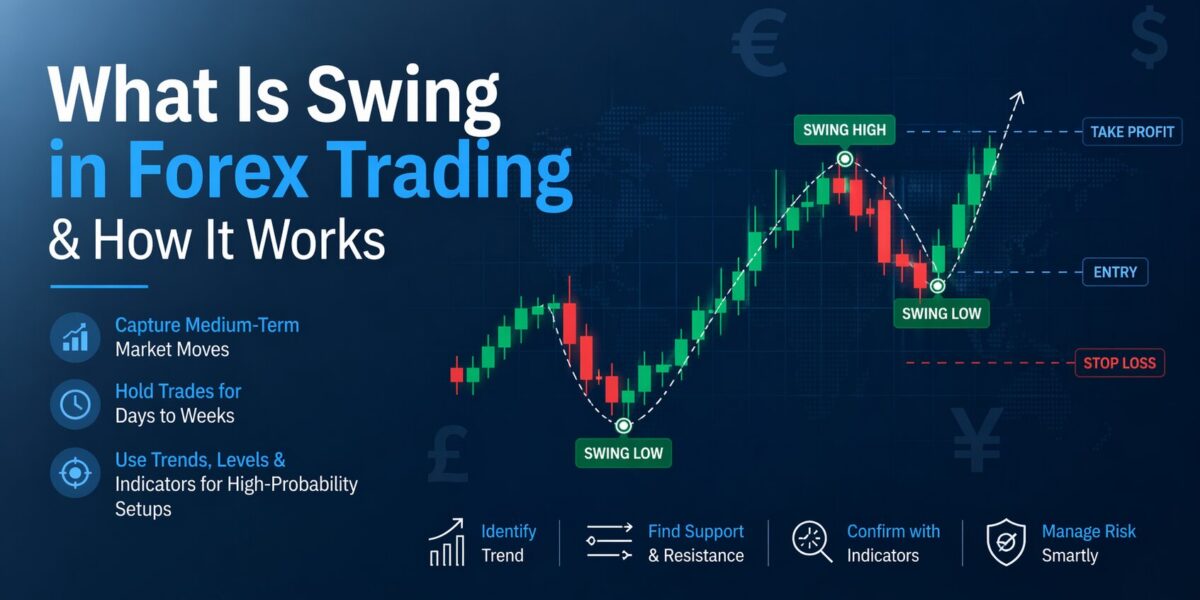
The foreign exchange market offers a multitude of ways to generate profit, catering to traders with varying levels of patience, capital, and risk tolerance. In the world of forex trading, while some thrive on the rapid-fire adrenaline of day trading and others prefer the slow, methodical approach of long-term investing, there is a powerful middle ground that attracts many professionals: swing trading forex.
This approach to forex trading focuses on capturing medium-term price movements, allowing traders to benefit from market swings without needing to monitor charts constantly throughout the day. It combines elements of both technical and fundamental analysis, making it a versatile strategy for those seeking balance.
As a result, swing trading has become a popular method in forex trading, especially for individuals who want flexibility while still aiming for consistent returns over time.
For those looking to navigate the global financial markets without being glued to a monitor every second of the day, understanding how swing trading works is essential. Whether you are trading your own personal account or managing capital for an Instant Prop funding firm, mastering this approach can provide a sustainable path to profitability. This comprehensive guide will explore the mechanics of the swing trading strategy, compare it to other methods, and outline the techniques needed to succeed.
Understanding the Mechanics of Swing Trading
At its core, swing trading is a medium-term trading style in forex trading that attempts to capture a portion of a larger market move. Instead of trying to predict the exact top or bottom of a trend, swing traders aim to ride the “swings” that naturally occur as prices oscillate upward or downward.
In forex trading, this approach allows traders to focus on high-probability setups rather than constant market monitoring, making it ideal for those who prefer a balanced trading routine. By identifying trends and key levels, traders can position themselves strategically to benefit from price movements.
Because of its flexibility, swing trading in forex trading is widely used by both beginners and experienced traders who want to combine analysis with patience while targeting consistent opportunities.
This approach requires a blend of patience and precision. By focusing on significant price swings in forex, traders can filter out the intraday noise and focus on the broader market narrative.
The Timeframe of a Swing Trade
Unlike short-term trading methods in forex trading, where positions are opened and closed within the same day, swing trading involves holding positions for days or even holding positions for weeks. This extended timeframe allows the market enough time to develop a meaningful directional move.
In forex trading, this approach gives traders the advantage of avoiding constant screen time while still capturing significant price movements. It also reduces the noise of smaller fluctuations that often affect intraday strategies.
Because of this, swing trading has become a preferred method in forex trading for those who want to balance time commitment with the potential for steady and strategic gains.
Because swing traders maintain medium-term positions, they must be comfortable with overnight positions. This means accepting the risk that prices may gap against them while they sleep, which makes proper position sizing and stop-loss placement absolutely critical.
Swing Trading vs Day Trading
When comparing swing trading vs day trading, the most obvious difference is the time commitment. Day traders must constantly monitor the charts, reacting to minute-by-market fluctuations. Swing traders, on the other hand, can often manage their portfolios by checking the charts just once or twice a day.
Furthermore, day trading relies heavily on capturing tiny price movements with large position sizes. Swing trading aims for much larger price movements, meaning traders can use smaller position sizes to achieve similar profit targets, thereby reducing the stress associated with intraday volatility.
Analyzing the Forex Market for Swing Opportunities
To successfully execute a forex swing trading strategy in forex trading, you must be able to identify when a market is preparing to make a significant move. This requires a comprehensive understanding of both the technical forces driving price action and the fundamental factors shaping the broader economic landscape.
In forex trading, traders often rely on indicators, chart patterns, and key support and resistance levels to anticipate potential breakouts or reversals. At the same time, keeping an eye on economic news and global events helps provide context to market movements.
By combining these elements, traders in forex trading can make more informed decisions and position themselves ahead of major price shifts, increasing the probability of successful trades.
Trading in forex is unique because currencies are always traded in pairs. Therefore, your analysis must account for the relative strength or weakness of both economies involved in the transaction.
The Role of Technical Analysis
Technical analysis is the primary tool used by swing traders in forex trading to identify entry and exit points. By studying historical price charts, traders look for recurring patterns that suggest a high probability of a specific future outcome.
In forex trading, this process involves analyzing candlestick formations, trend lines, and key indicators to better understand market behavior. These insights help traders anticipate potential price movements with greater confidence.
By consistently applying technical analysis in forex trading, traders can refine their strategies, improve timing, and increase the likelihood of capturing profitable market swings.
A cornerstone of this analysis is identifying support and resistance levels. Support acts as a price floor where buying pressure historically overcomes selling pressure, while resistance acts as a ceiling. Swing traders often look to buy near support during an uptrend and sell near resistance during a downtrend, using these levels to define their risk.
Integrating Fundamental Analysis
While technicals provide the timing, fundamental analysis provides the context. Swing traders must be aware of major economic events—such as central bank interest rate decisions, inflation reports, and employment data—because these events dictate the long-term trend direction.
If the technical charts suggest a bullish swing setup, but the fundamental data for that currency is overwhelmingly negative, a prudent swing trader might pass on the opportunity. The best swing trading strategies align technical entry signals with the underlying fundamental narrative.
Developing a Profitable Swing Trading Strategy
Many beginners ask, “is swing trading profitable?” The answer is yes, but only if executed with a disciplined, systematic approach. Profitability does not come from winning every trade; it comes from ensuring that your winning trades are significantly larger than your losing trades.
To achieve this, you must develop a robust framework that dictates exactly how you will engage with the market, manage your capital, and handle the inevitable psychological pressures of trading.
Identifying Market Trends Forex
The old adage “the trend is your friend” is particularly relevant for swing traders. Trading trends is generally much easier and more profitable than trying to pick tops and bottoms in a ranging market.
When analyzing market trends forex, traders look for a series of higher highs and higher lows to confirm an uptrend, or lower highs and lower lows to confirm a downtrend. Once the trend is established, the swing trader waits for a counter-trend pullback (a “dip” in an uptrend or a “rally” in a downtrend) to enter the market at a favorable price, anticipating that the primary trend will resume.
Selecting the Right Currency Pairs
Not all currency pairs are suitable for swing trading. Because this strategy relies on capturing significant price movements, traders need pairs that exhibit clear directional trends and sufficient market volatility.
Generally, the major pairs (such as EUR/USD, GBP/USD, and USD/JPY) are the best choices for swing trading forex for beginners. These are highly liquid markets, meaning they offer tight spreads and reliable execution, which reduces the friction costs associated with entering and exiting trades.
Risk Management and Trading Psychology
Even the most sophisticated forex trading strategies explained in perfect detail will fail without strict risk management and emotional control. Because swing traders hold positions for extended periods, they are exposed to a wider range of market variables than day traders.
Protecting your capital must always be your primary objective. If you can survive the inevitable losing streaks, the winning swings will eventually take care of your profitability.
Mastering the Risk-Reward Ratio
The foundation of swing trading risk management is the risk-reward ratio. This ratio compares the amount of money you are willing to lose on a trade (your risk) to the amount you expect to make (your reward).
Professional swing traders typically aim for a minimum risk-reward ratio of 1:2 or 1:3. This means that for every dollar they risk, they expect to make two or three dollars in return. By maintaining a positive risk-reward ratio, a trader can be wrong on more than half of their trades and still remain profitable over the long term.
Navigating Trading Psychology
The psychological demands of swing trading are unique. Unlike day traders who close all positions before logging off, swing traders must learn to detach themselves from the market while their trades are active. Watching every minor tick of price action can lead to emotional exhaustion and poor decision-making.
Successful trading psychology in this context means trusting your analysis, accepting that forex market conditions will fluctuate, and allowing the trade enough room to breathe. If you have placed your stop-loss correctly and your risk is managed, you must have the discipline to let the market do its work without premature interference.