For anyone stepping into the world of currency trading, one of the most fundamental concepts to grasp is the forex spread. It is the invisible toll gate of the financial markets, a built-in cost that affects every single transaction you make. Whether you are trading a micro account with a few hundred dollars or managing significant capital for an Instant Prop funding firm, understanding how spreads work is absolutely critical to your long-term success.
Many novice traders focus entirely on predicting market direction, spending hours analyzing charts and economic data, only to find their accounts slowly bleeding money. Often, the culprit is a lack of understanding regarding the spread in forex. This comprehensive guide will break down exactly what is spread in forex, how it is calculated, the factors that cause it to fluctuate, and how you can manage it to ensure profitable forex trading.
The Mechanics of the Bid Ask Spread: Spread in Forex
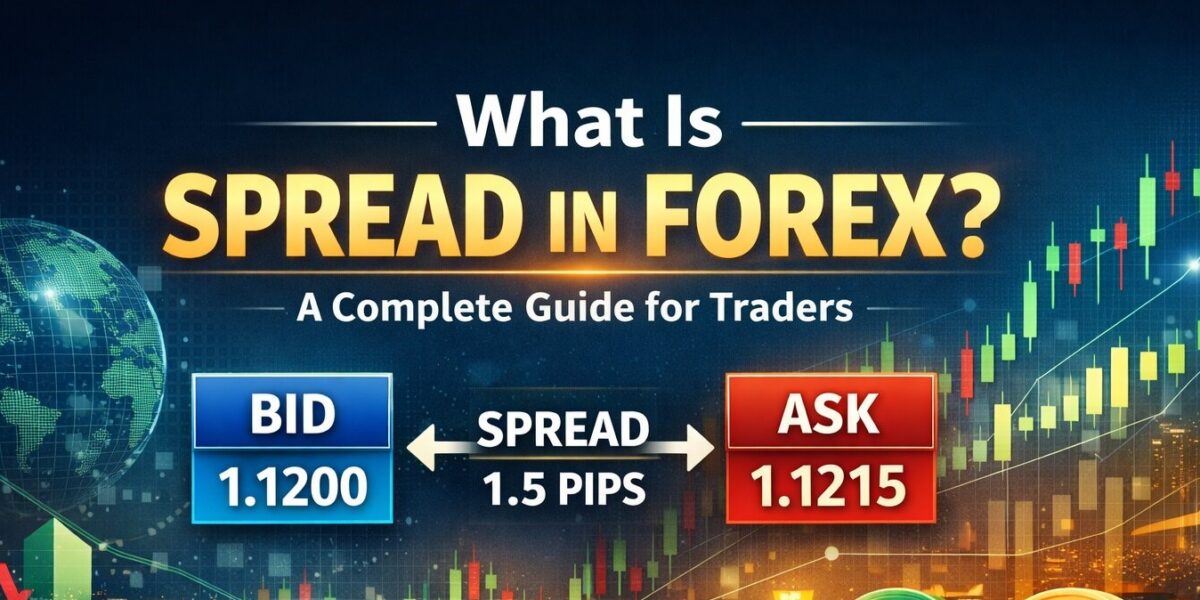
To understand the spread, you must first understand how currencies are priced. In the forex trading market, currencies are always traded in pairs, such as the EUR/USD or GBP/JPY. When you look at a quote for any of these currency pairs, you will never see just one price. Instead, you will always be presented with two distinct prices: the bid and the ask.
The relationship between these two prices forms the foundation of the bid ask spread. It is the mechanism through which brokers and market makers generate their revenue, acting as a transaction fee for facilitating your trade in the global marketplace. In simple terms, the Spread in Forex reflects the cost of entering a trade and directly impacts profitability. A tighter Spread in Forex means lower trading costs, while a wider Spread in Forex can reduce potential gains. Traders must always consider this factor when planning entries and exits.
Understanding the Bid Price
The bid price is the maximum price that a buyer (the broker or market maker) is willing to pay for the base currency in a pair. From your perspective as a retail trader, the bid price is the price at which you can sell the currency pair. If you believe the market is going to go down and you want to open a short position, your order will be executed at the bid price. This concept plays a key role in understanding the Spread in Forex, as the bid price forms one side of the price difference. A clear understanding of the Spread in Forex helps traders make better entry decisions and manage costs effectively.
Similarly, if you have an open long (buy) position that is currently in profit, and you decide to close that trade to secure your gains, you will be selling your position back to the market at the current bid price.
Understanding the Ask Price
Conversely, the ask price (sometimes referred to as the offer price) is the minimum price that a seller is willing to accept for the base currency. For you, the trader, this is the price at which you can buy the currency pair. If your analysis suggests the market is heading upward and you want to open a long position, you will pay the ask price. This price forms the upper side of the Spread in Forex, directly influencing your entry cost. Understanding the Spread in Forex helps traders evaluate trade efficiency, while a wider Spread in Forex can increase overall trading expenses and impact profitability.
The ask price is always slightly higher than the bid price. The difference between these two numbers is the trading spread. Because you always buy at the higher ask price and sell at the lower bid price, every new trade you open will immediately start slightly in the negative. The market must move in your favor by an amount equal to the spread just for your trade to break even.
How the Currency Pair Spread is Measured
In the forex market, price movements are incredibly small, often measured in fractions of a cent. To standardize these microscopic movements, the industry uses a unit of measurement known as a pip. Understanding pips is essential for calculating the exact cost of your currency pair spread. This is where the Spread in Forex becomes easier to quantify, as it is typically expressed in pips. A clear grasp of Spread in Forex allows traders to evaluate trading costs more accurately, while even a small change in the Spread in Forex can significantly impact overall profitability.
While the concept might seem abstract at first, calculating the spread in pips becomes second nature with a little practice, allowing you to quickly assess the cost of doing business before you enter a trade.
The Role of Pips in Spread Calculation
The term “pips” stands for “Percentage in Point” or “Price Interest Point.” For most major currency pairs, a pip represents the fourth decimal place in the exchange rate. For example, if the EUR/USD moves from 1.1050 to 1.1051, that is a movement of one pip. The notable exception is currency pairs involving the Japanese Yen (JPY), where a pip is represented by the second decimal place.
To calculate the spread, you simply subtract the bid price from the ask price. If the EUR/USD has a bid price of 1.1050 and an ask price of 1.1052, the spread is 2 pips. If you are trading a standard lot ($100,000), a 2-pip spread equates to a $20 transaction cost that you must overcome to achieve profitability.
Fixed vs. Variable Spreads
When choosing a broker, you will typically encounter two types of spreads: fixed and variable. Fixed spreads remain constant regardless of market conditions and are often offered by market-maker brokers who act as the counterparty to your trades. While fixed spreads provide predictability, they are generally wider than the average variable spread to protect the broker from sudden market shifts. This directly impacts the Spread in Forex, as fixed pricing can mean consistently higher trading costs. Understanding how fixed pricing affects the Spread in Forex helps traders manage risk more effectively, especially during volatile conditions where the Spread in Forex can influence overall trade performance.
Variable (or floating) spreads, on the other hand, fluctuate constantly based on real-time supply and demand. During periods of high liquidity, variable spreads can be incredibly tight, sometimes dropping to zero on professional accounts. However, during volatile periods, these spreads can widen significantly, increasing your trading costs dramatically.
Factors That Influence the Spread
If you are trading with a broker that offers variable spreads, you will quickly notice that the gap between the bid and ask price is constantly expanding and contracting. The spread is not an arbitrary number; it is a live reflection of the current state of the market.
Understanding the forces that drive these fluctuations is crucial for timing your entries and exits. Several key factors dictate whether you will pay a fraction of a pip or several pips to execute your trade.
The Impact of Liquidity in Forex
Liquidity in forex is the single most important factor determining the size of the spread. Liquidity refers to the volume of active buyers and sellers in the market at any given moment. When liquidity is deep, there is fierce competition among market participants to fill orders, which naturally drives the spread down.
Major currency pairs like the EUR/USD and USD/JPY boast massive liquidity, resulting in the tightest spreads in the industry. Conversely, exotic pairs like the USD/TRY (US Dollar/Turkish Lira) have far fewer participants. This lack of liquidity means market makers take on more risk to facilitate trades, resulting in significantly wider spreads. This difference clearly highlights how the Spread in Forex is influenced by liquidity levels. Highly liquid pairs tend to offer a lower Spread in Forex, reducing trading costs, while less liquid markets lead to a higher Spread in Forex, which can impact profitability and trading strategy decisions.
Trading Volume and Market Volatility
Trading volume goes hand-in-hand with liquidity. High volume periods generally feature tight spreads. However, market volatility can disrupt this relationship. Volatility refers to the speed and magnitude of price changes. While high volatility can present excellent trading opportunities, it also introduces significant risk for liquidity providers.
When prices are moving erratically, market makers will rapidly widen their spreads to protect themselves from being caught on the wrong side of a sudden price spike. Therefore, a highly volatile market will almost always feature wider spreads, even if the overall trading volume remains relatively high.
Timing Your Trades for Optimal Spreads
Because spreads fluctuate based on liquidity and volatility, the time of day you choose to trade has a massive impact on your transaction costs. The forex market is open 24 hours a day, five days a week, but the level of activity varies dramatically depending on which global financial centers are currently open.
Mastering the rhythm of the trading day allows you to minimize your costs and maximize your edge in the market.
The Trading Session Impact
The global forex day is divided into three major sessions: the Asian (Tokyo) session, the European (London) session, and the North American (New York) session. The trading session impact on spreads is profound. During the Asian session, liquidity is generally lower, leading to slightly wider spreads on pairs that do not involve the Yen or Australian Dollar.
The tightest spreads of the day occur during the overlap between the London and New York sessions (typically 8:00 AM to 12:00 PM EST). During this four-hour window, the two largest financial hubs are active simultaneously, providing maximum liquidity and the most favorable trading conditions for major currency pairs.
Navigating Economic Events Forex
Perhaps the most dangerous time for spread widening is during major economic events forex. When critical data is released—such as the US Non-Farm Payrolls (NFP), inflation reports, or central bank interest rate decisions—liquidity providers often pull their orders from the market to avoid the unpredictable fallout.
This sudden vacuum of liquidity causes spreads to widen violently, sometimes jumping from 1 pip to 10 or 20 pips in a matter of milliseconds. Trading directly during these news events is highly risky, as the widened spread combined with severe price slippage can trigger stop-losses and decimate a trading account before the market direction even becomes clear.
Strategies for Managing Spread Costs
Now that you understand what the spread is and why it fluctuates, the final step is learning how to manage it. Ignoring the spread is a guaranteed way to erode your trading capital over time. Professional traders treat the spread as a critical business expense that must be aggressively minimized.
Implementing strict rules regarding when and what you trade can significantly improve your bottom line and help you achieve consistent profitability.
Aligning Strategy with Market Conditions
Your trading strategy must be aligned with the prevailing market conditions and the typical spread of your chosen pairs. For example, scalpers who aim to capture tiny profits of 5 to 10 pips are highly sensitive to the spread. If a scalper pays a 2-pip spread, they are giving up 20% to 40% of their potential profit just to enter the trade. Therefore, scalpers must restrict their trading to the most liquid pairs during peak hours.
Swing traders, who hold positions for days or weeks aiming for 100+ pip moves, are far less affected by a 2-pip spread. However, even long-term traders should avoid entering positions during major news events or the daily market rollover (5:00 PM EST), when spreads temporarily widen as banks reconcile their books.
Leveraging High Leverage Opportunities
Many traders turn to prop firms to access high leverage opportunities and institutional-grade trading conditions. Because these firms aggregate massive trading volume, they can often negotiate raw, interbank spreads from their liquidity providers, passing those ultra-tight spreads on to their funded traders.
By trading with a reputable firm, you can significantly reduce your transaction costs compared to a standard retail brokerage account. This reduction in spread friction, combined with access to substantial capital, provides a much clearer path to sustainable, professional-level trading success.