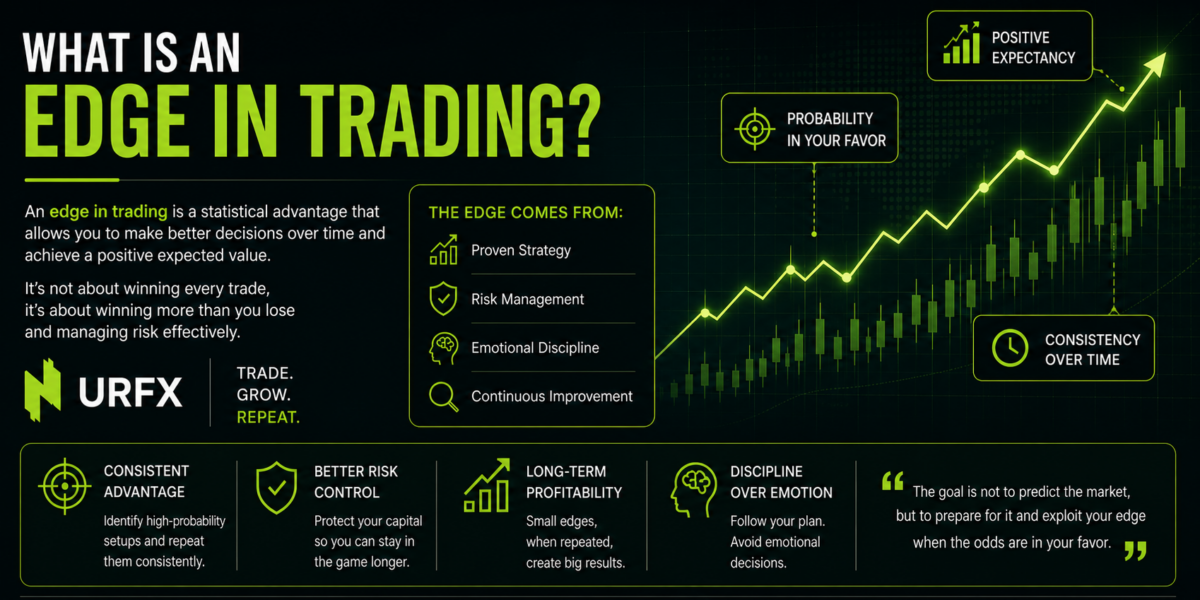
In the highly competitive arena of financial markets, success is rarely the result of luck or intuition. Instead, consistent profitability is built upon a foundation known as a trading edge. Many novice traders enter the market believing that an edge is a secret indicator or a flawless system that guarantees a win on every trade. However, the reality is far more nuanced. A trading edge is a statistical advantage that, when applied consistently over a large number of trades, yields a positive expected value. It is the difference between gambling and professional trading.
A strong edge in trading is developed through discipline, testing, and risk control, allowing traders to refine their edge in trading over time and maintain a reliable edge in trading even in changing market conditions.
Whether you are trading your own capital or operating through an Instant Prop funding firm, understanding, developing, and maintaining a personal trading edge is the single most important factor in your long-term success. This article explores the multifaceted nature of a trading edge, delving into the mechanics of strategy development, the critical role of psychology, and the indispensable nature of risk management.
Defining the Trading Edge
To truly understand what constitutes an edge, we must first dispel the myth of certainty. A trading edge does not mean you will win every trade; it simply means that the probability of a favorable outcome is higher than the probability of an unfavorable one, or that your winning trades are significantly larger than your losing trades.
At its core, a trading edge is defined by positive expected value (EV). This mathematical concept calculates the average outcome of a trade if it were repeated infinitely. It is determined by two primary factors: your win rate (the percentage of profitable trades) and your risk-to-reward ratio.
A strategy with a 40% win rate can still possess a powerful edge if the average winner is three times larger than the average loser, showing how a true edge in trading is built on smart risk-reward balance rather than just accuracy. Conversely, a strategy with a 90% win rate can have a negative expected value if a single loss wipes out dozens of small gains, proving that without proper structure, an edge in trading cannot be sustained. Ultimately, mastering this balance is what allows traders to develop a consistent edge in trading and achieve long-term profitability.
The Mathematics of Advantage
At its core, a trading edge is defined by positive expected value (EV). This mathematical concept calculates the average outcome of a trade if it were repeated infinitely, forming the foundation of any sustainable edge in trading. It is determined by two primary factors: your win rate (the percentage of profitable trades) and your risk-to-reward ratio, both of which directly shape your overall edge in trading.
A strategy with a 40% win rate can still possess a powerful edge if the average winner is three times larger than the average loser, demonstrating how a well-structured edge in trading relies more on reward asymmetry than high accuracy. Conversely, a strategy with a 90% win rate can have a negative expected value if a single loss wipes out dozens of small gains.
Understanding this mathematical reality is crucial for performance evaluation. It shifts the trader’s focus from the outcome of individual trades to the aggregate profitability over time. This perspective is essential for maintaining discipline during inevitable losing streaks.
Types of Trading Edges
Edges can manifest in various forms, but they generally fall into a few distinct categories. A structural edge exploits the mechanics of the market itself, such as liquidity patterns or specific market behaviour during opening hours. A behavioral edge capitalizes on the predictable psychological reactions of other market participants, such as panic selling or euphoric buying. Finally, an execution edge is derived from superior technology, faster reaction times, or more efficient order routing. Most successful traders combine elements of these different types to form a robust, repeatable strategy.
The Role of Trading Psychology : Edge in Trading
While a mathematical advantage is necessary, it is entirely useless without the mental fortitude to execute it, as a true edge in trading depends not only on numbers but also on disciplined behavior. Trading psychology is often the differentiating factor between those who possess a theoretical edge and those who actually make money, because without emotional control, even a proven edge in trading can break down under pressure. Ultimately, consistency in mindset is what allows traders to protect and apply their edge in trading effectively over time.
Mastering Emotional Discipline
Emotional discipline is the bedrock of successful execution and a key driver of any sustainable edge in trading. The market is a chaotic environment that constantly triggers primal emotions, primarily fear and greed, both of which can weaken a trader’s edge in trading if left unmanaged. Fear can cause a trader to exit a winning position prematurely or hesitate to take a valid setup, while greed can lead to holding losing positions in the hope they will turn around, or taking excessive risks to maximize profits—ultimately damaging the consistency of their edge in trading.
Maintaining emotional discipline means adhering to your entry and exit rules regardless of how you feel. It requires a deep understanding of the battle between confidence vs doubt. A trader must have absolute confidence in their edge over a large sample size, while simultaneously maintaining enough doubt about any single trade to respect their stop losses.
The Dangers of Overtrading
One of the most common ways traders sabotage their edge is through overtrading. This occurs when a trader takes setups that do not meet their strict criteria, often out of boredom, a desire for action, or an attempt to quickly recover from a loss. Overtrading dilutes the statistical advantage of a strategy by introducing random, low-probability events into the sample size.
To combat this, professional traders focus heavily on mental performance. They recognize that preserving mental capital is just as important as preserving financial capital. By maintaining focus and waiting patiently for high-probability setups, they ensure that their edge is fully realized.
Strategy Development and Validation
A trading edge is not found; it is meticulously developed and rigorously tested. The process of strategy development requires a systematic approach to analyzing data and refining rules.
The Importance of Backtesting
Before risking real capital, a strategy must be validated through backtesting. This involves applying your entry and exit rules to historical market data to see how the strategy would have performed in the past. Historical data analysis allows traders to quantify their edge, determine their expected win rate, and understand the typical drawdowns associated with their approach.
However, backtesting is not foolproof. Traders must be wary of curve-fitting, which is the process of optimizing a strategy so perfectly to past data that it fails completely in live market conditions. A robust strategy should perform well across various market environments and timeframes.
Transitioning to Live Markets
Once a strategy has shown promise in backtesting, the next step is paper trading or demo account trading. This phase allows the trader to practice trade execution in real-time without financial risk. It helps identify logistical issues, such as slippage or platform latency, and provides an opportunity to test the trader’s psychological resilience.
Only after a strategy has proven successful in both backtesting and simulated environments should it be applied to live markets. Even then, strategy refinement is an ongoing process. Markets evolve, and a strategy that worked brilliantly last year may lose its edge today. Continuous monitoring and adaptation are essential.
Risk Management as an Edge
Many traders view risk management as a defensive measure designed solely to prevent ruin. However, professional traders understand that superior risk management is, in itself, a powerful trading edge.
Capital Preservation and Position Sizing
The primary goal of any trader must be capital preservation. If you lose your capital, you lose your ability to participate in the market and realize your edge. This is where position sizing becomes critical. By carefully calculating the size of each trade relative to the total account balance, traders ensure that no single loss can cause catastrophic damage.
A common Risk Management Technique is the risk per trade (1% rule). This rule dictates that a trader should never risk more than 1% of their total capital on any single trade. This conservative approach to position risk ensures that a trader can survive a string of consecutive losses—a statistical inevitability—without suffering a debilitating drawdown.
Implementing Strict Loss Limits
In addition to per-trade risk, traders must implement broader loss limits (daily/weekly/monthly). These limits act as circuit breakers, preventing a trader from spiraling into a cycle of revenge trading after a series of losses. When a daily loss limit is hit, the trader must walk away from the screens, regardless of how tempting the market looks.
Effective drawdown control is essential for long-term survival. By utilizing stop-loss orders religiously and adhering to strict loss limits, traders protect their psychological capital as well as their financial capital. This disciplined approach to risk ensures that they live to trade another day, allowing their statistical edge to eventually manifest in the form of consistent profits.
Maintaining and Refining Your Edge
A trading edge is not a static entity; it is a dynamic advantage that must be actively maintained. The market is a complex, adaptive system, and what works today may not work tomorrow.
The Power of the Trading Journal
The most effective tool for maintaining an edge is a comprehensive trading journal. A journal is more than just a ledger of profits and losses; it is a detailed record of the trader’s decision-making process, emotional state, and execution accuracy. By meticulously logging every trade, traders can identify patterns in their behavior and pinpoint areas where they are deviating from their strategy.
Regular review of the trading journal is crucial for performance evaluation. It allows traders to objectively assess whether their edge is still intact or if market conditions have shifted. It also highlights psychological weaknesses, such as a tendency to move stop losses or exit winning trades too early.
Continuous Strategy Refinement
Based on the insights gained from the trading journal, traders must engage in continuous strategy refinement. This might involve adjusting position sizing parameters, tweaking entry criteria, or adapting to new volatility regimes. The goal is not to constantly change strategies, but to optimize the existing repeatable strategy to ensure it remains aligned with current market behaviour.
Ultimately, an edge in trading is the culmination of statistical probability, flawless execution, psychological resilience, and rigorous risk management. It is a holistic approach to the markets that separates the professionals from the amateurs. By dedicating yourself to the continuous development and refinement of your personal trading edge, you position yourself for sustainable success in the challenging world of trading.