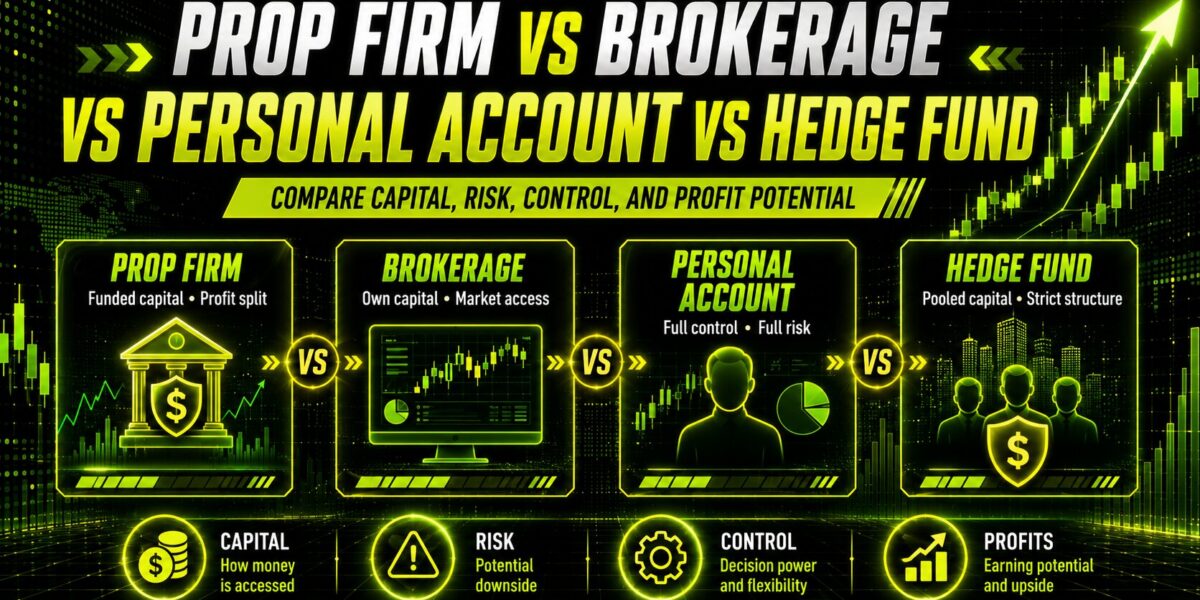
The global financial landscape offers diverse pathways for individuals seeking to capitalize on market movements. Historically, traditional trading through a personal trading account was the standard entry point for retail participants. However, the modern trading ecosystem has evolved, giving rise to distinct models such as proprietary trading firms, brokerage-based trading, and private investment funds like hedge funds. For any participant navigating the financial markets, understanding Prop Firm vs Brokerage is essential because each model offers different levels of capital access, risk exposure, trading flexibility, and profit potential.
When comparing Prop Firm vs Brokerage, traders need to look beyond basic account access and consider how each option affects decision-making, funding requirements, trading rules, and long-term growth. A prop firm may provide access to larger trading capital with structured rules and profit splits, while a brokerage allows traders to use their own funds with greater independence. This makes the Prop Firm vs Brokerage comparison an important starting point before deciding whether a personal account or hedge fund structure better matches your trading goals.
Understanding the structural, financial, and regulatory differences between these models is essential. Whether comparing a prop firm vs broker or evaluating the merits of a prop firm vs personal account, each option presents unique trade-offs in terms of capital access, risk management, and profit-sharing opportunities. This article provides a comprehensive comparative analysis of prop firms, traditional brokerages, personal accounts, and hedge funds, enabling you to align your trading activities with the most suitable financial structure.
1. Traditional Trading vs Prop Trading: Core Business Models
To appreciate the differences between various market access vehicles, we must first analyze the fundamental shift represented by Traditional Trading vs Prop Trading. This comparison highlights how capital is sourced, managed, and utilized across different trading environments.
Sourcing Capital and Risk Exposure: Prop Firm vs Brokerage
In traditional broker-based trading, a trader operates a personal trading account funded entirely with their own funds. This personal capital represents the extent of their trading capital, and they bear 100% of the financial risk. If their trading activities result in a losing trade, they are fully responsible for all trading losses, which are deducted directly from their personal capital. Conversely, prop firms do not require traders to deposit their own funds for live trading. Instead, prop firms provide successful traders with access to simulated accounts funded with virtual funds or simulated funds. The firm absorbs the actual financial risk of the market, offering a environment of reduced personal risk and limited losses, while the trader’s downside is strictly capped.
Account Structures and Evaluation Services
Prop trading models typically utilize structured evaluation services to identify skilled traders. To gain access to virtual funds, participants must purchase a challenge account, such as the FundedNext Challenge, which serves as a test of their trading performance and risk management skills. When comparing Prop Firm vs Brokerage, this evaluation stage is one of the biggest differences because prop firms require traders to prove consistency before accessing larger simulated capital.
These trading simulation challenges are governed by strict account rules, including a maximum drawdown limit and daily loss thresholds. In contrast, a standard brokerage trading account does not require evaluation results or challenge phases. Once a trader opens an account with a broker, they can immediately begin live trading with real financial instruments, subject only to standard broker commissions and broker fees. This makes the Prop Firm vs Brokerage decision important for traders who want to understand whether structured rules or direct market access better suits their goals.
Unlike traditional brokers, prop firms do not provide personalized investment advice. Therefore, the Prop Firm vs Brokerage comparison depends on a trader’s capital needs, risk tolerance, discipline, and preferred level of trading independence.
2. Capital Access, Account Sizes, and Cost Structures
The scale at which a trader can operate is heavily dictated by their available capital. Comparing the cost structures of prop firms and traditional brokerages reveals vastly different levels of financial leverage and capital efficiency.
| Feature / Metric | Proprietary Trading Firm | Traditional Brokerage (Personal Account) |
| Primary Capital Source | Firm’s Corporate Capital (Virtual/Simulated) | Trader’s Personal Capital (Own Funds) |
| Upfront Financial Cost | Fixed Cost of Account (Evaluation Fee) | Variable Capital Deposit (Minimum Balance) |
| Account Size Potential | $25,000 to $200,000+ per Challenge | Limited to Deposited Personal Capital |
| Risk of Losing Trades | Capped at the Initial Cost of Account | Unlimited (Losses Deducted from Own Funds) |
| Leverage Structure | Internal Risk-Controlled Leverage | Broker-Provided Margin (Full Personal Liability) |
| Additional Expenses | Optional Add-ons, Account Resets | Broker Commissions, Spreads, Inactivity Fees |
Scaling Account Size with Prop Capital
For many retail traders, the primary obstacle to professional success is an insufficient account size. Growing a small personal trading account using only personal capital is an incredibly slow process that often leads to excessive risk-taking. This is where the Prop Firm vs Brokerage comparison becomes important, because each option gives traders a very different way to access the markets and manage capital.
Prop firms solve this problem by decoupling the account size from the trader’s personal net worth. For a relatively small, one-time fee—the cost of account—a trader can access a $50,000, $100,000, or even $200,000 challenge account. In the Prop Firm vs Brokerage model, the key difference is that prop firms provide access to larger virtual capital, while brokerage accounts depend entirely on the trader’s own deposited funds.
This enables traders to operate at a professional trading scale that would otherwise be difficult or impossible with limited personal savings. Therefore, understanding Prop Firm vs Brokerage helps traders decide whether they prefer funded capital with rules or full independence with personal financial responsibility.
Fixed Costs vs. Ongoing Transaction Fees
The cost structure of prop trading is defined by fixed costs. A trader pays an upfront fee for evaluation services and any optional add-ons, such as account resets or extended time limits. When analyzing Prop Firm vs Brokerage, this fixed-cost model becomes a major advantage because traders know their maximum financial exposure before entering the evaluation process.
If the trader fails the evaluation due to a breach of account rules, they lose only the fee paid. In traditional broker-based trading, the costs are ongoing and variable. Full-service brokers and discount brokers charge broker commissions, spreads, swap fees, and platform maintenance fees on every transaction volume. This makes the Prop Firm vs Brokerage comparison important for traders who want to understand whether they prefer predictable upfront costs or continuous trading expenses.
Furthermore, while brokers offer leveraged accounts, the trader remains personally liable for any losses that exceed their deposited funds, creating a much higher level of financial risk. Therefore, understanding Prop Firm vs Brokerage helps traders evaluate cost, liability, trading freedom, and long-term risk before choosing the right trading model.
3. Risk Management, Drawdowns, and Regulatory Guardrails
Risk management is the cornerstone of survival in the financial markets. The way risk is structured and regulated differs dramatically when comparing prop trading, traditional brokerages, and the broader institutional space.
Strict Drawdown Rules in Prop Trading
Prop firms protect their corporate capital by enforcing automated risk management protocols. Every challenge account is bound by a maximum drawdown rule, which dictates the maximum cumulative loss the account can sustain before being terminated. If a trader experiences a severe losing trade that breaches these daily or overall drawdown limits, the account is automatically closed. While this structure may seem rigid, it provides a powerful educational framework that prevents catastrophic losses, ensuring that successful traders develop highly disciplined risk management habits.
Regulatory Disclosures and Hypothetical Results
Traditional brokerages are heavily regulated financial institutions. They are required by law to segregate client funds and provide extensive risk disclosures to protect retail investors. Because many prop firms operate simulated accounts in a demo environment during their evaluation phases, they are subject to different regulatory standards. In the United States, for instance, firms must comply with CFTC Rule 4.41 regarding the presentation of hypothetical trading results. This rule requires a clear risk disclosure explaining that simulated or hypothetical trading results do not represent actual live trading and have inherent limitations, as they do not involve real financial risk or actual market execution.
4. Profit Splits, Payouts, and Performance-Based Income
The ultimate goal of any trading activity is financial reward. The mechanism through which profits are realized and distributed represents one of the most significant distinctions between personal accounts and proprietary firms.
Performance-Based Profit Splits
In a personal trading account, the trader keeps 100% of the profits generated from their trading activities, minus broker commissions and fees. However, because their trading scale is limited by their personal capital, their absolute profit potential remains low. Prop firms operate on a profit-sharing model. Successful traders who pass the evaluation services and adhere to the account rules are rewarded with performance-based profits and profit splits. At leading firms like FundedNext, these profit-sharing opportunities and profit sharing models can be as high as 95% of the generated profits, maximizing the trader’s overall trading potential.
Prop Firm Payouts and Instant Funding
To receive a payout from a prop firm, a trader must consistently demonstrate strong trading performance. Prop firm payouts are typically processed on a bi-weekly or monthly basis, depending on the specific model chosen (such as FundedNext CFDs or FundedNext Futures). For traders who wish to bypass the evaluation phase entirely, some organizations partner with an instant prop funding firm. An instant prop funding firm provides immediate access to a funded account with profit-sharing opportunities from day one, although these accounts typically feature smaller initial sizes and more conservative profit splits to offset the firm’s immediate financial risk.
5. Asset Classes, Platforms, and Community Ecosystems
The operational environment of a trader—including the asset classes they trade, the trading platform they use, and the community they interact with—plays a vital role in their day-to-day execution and mental well-being.
Accessing Global Financial Markets
Both traditional brokers and prop firms provide access to a wide range of asset classes across global financial markets. Depending on the platform, traders can engage in:
- Forex Trading: Executing trades on major and minor forex pairs.
- Indices and Commodities: Trading global stock indices and physical commodities like gold and oil.
- Crypto and Derivatives: Accessing cryptocurrency markets, CFDs, and futures trading (such as FundedNext Futures or FundedNext CFDs).
Traditional brokerages often specialize in specific asset classes, whereas modern prop firms typically provide a unified trading dashboard that allows traders to diversify their strategies across multiple markets simultaneously.
The Power of Trading Communities and Support
One of the overlooked advantages of modern prop firms is the ecosystem they build around their traders. Traditional retail trading is often a solitary and isolating endeavor. In contrast, leading prop firms actively foster a vibrant trading community. This is typically facilitated through an official Discord group, where traders can share strategies, discuss market access conditions, and celebrate successful payouts. Furthermore, prop firms provide robust technical support, educational resources, interactive dashboards, and other valuable trading resources at no extra cost, offering a level of support that discount brokers simply cannot match.
6. Comparing Hedge Funds: The Institutional Pinnacle
To complete our analysis of the prop trading landscape, we must examine the hedge fund model. A hedge fund represents the traditional pinnacle of institutional asset management, operating under vastly different structural and regulatory frameworks than both prop firms and personal trading accounts.
External Capital Pooling and the “Two and Twenty” Fee Structure
Unlike prop firms that use corporate capital, or retail traders who use personal capital, hedge funds pool client funds from external investors, such as high-net-worth individuals and institutional clients. The hedge fund manager is responsible for deploying this aggregated capital across various financial markets to generate absolute returns. Historically, hedge funds have been compensated through a “two and twenty” fee structure: a 1% to 2% annual asset management fee based on the fund’s Net Asset Value (NAV), plus a 15% to 20% performance fee on the profits generated, subject to a high-water mark.
Regulatory Scrutiny and Accredited Investor Requirements
Because hedge funds manage real client funds, they are subject to intense regulatory scrutiny by organizations like the SEC or FCA. Unlike brokerages or prop firms, hedge funds are not marketed to retail investors. They are restricted to accredited investors or qualified purchasers who meet strict income, net worth, or professional sophistication criteria. While a prop trader can start trading a challenge account with as little as $50, entering a hedge fund typically requires a minimum investment of $1 million or more. This institutional structure prioritizes capital preservation, regulatory compliance, and sophisticated hedging strategies over the aggressive, high-leverage trading styles often seen in the retail prop space.