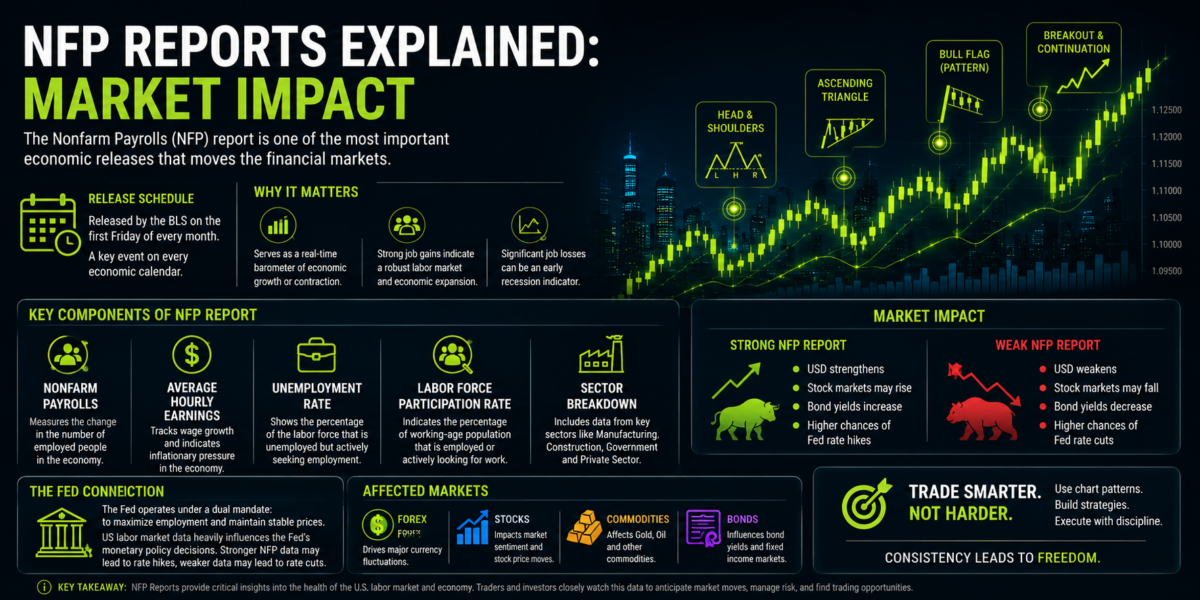
In the fast-paced world of global finance, few economic indicators command as much attention as the NFP Reports. For traders, investors, and economists alike, understanding what is nonfarm payroll and its profound nonfarm payroll impact is essential for navigating the complexities of the Financial Markets. This comprehensive guide explores the nonfarm payroll meaning, its role as a critical Economic Indicator, and how it shapes everything from Federal Reserve policy to Forex Market volatility. Whether you are analyzing a Trading Chart or managing capital through an Instant Prop funding firm, mastering the nuances of the U.S. Jobs Report is a fundamental requirement for success.
Understanding the Nonfarm Payroll Report
The Nonfarm Payroll (often abbreviated as NFP) is a key component of the broader Employment Situation Report released monthly by the Bureau of Labor Statistics (BLS). This Bureau of Labor Statistics report provides a detailed snapshot of the U.S. Economy by measuring the net number of jobs created or lost in the previous month.
What Does the NFP Data Include?
The nonfarm payroll data specifically tracks Payroll Employment across the nation, excluding farm workers, private household employees, and non-profit organization staff. The monthly employment report is derived from two primary sources: the establishment survey (which provides the payroll numbers today) and the Household Survey (which calculates the Unemployment Rate). The report breaks down Job Creation into various sectors, including Private Sector Employment, Government Employment, Manufacturing Jobs, and Construction Employment.
Understanding NFP Reports is extremely important for traders and investors because these reports provide insights into the overall health of the U.S. economy and labor market conditions. Strong or weak NFP Reports can significantly impact forex markets, stock prices, commodities, and Federal Reserve interest rate expectations. Many professional traders closely monitor NFP Reports every month to identify market volatility, analyze economic momentum, and make more informed trading decisions based on employment trends and wage growth data.
The Significance of the BLS Release
The BLS releases this macroeconomic news event typically on the first Friday of every month. The NFP release date is marked on every economic calendar NFP because it serves as a real-time barometer of Economic Growth or contraction. Strong Job Gains indicate a robust Labor Market and overall Economic Expansion, while significant Job Losses can serve as an early Recession Indicator.
The BLS releases this macroeconomic news event typically on the first Friday of every month. The NFP release date is marked on every economic calendar NFP because it serves as a real-time barometer of Economic Growth or contraction. Strong Job Gains indicate a robust Labor Market and overall Economic Expansion, while significant Job Losses can serve as an early Recession Indicator.
The BLS releases this macroeconomic news event typically on the first Friday of every month. The NFP release date is marked on every economic calendar NFP because it serves as a real-time barometer of Economic Growth or contraction. Strong Job Gains indicate a robust Labor Market and overall Economic Expansion, while significant Job Losses can serve as an early Recession Indicator.
For traders and investors, NFP Reports are considered one of the most influential economic indicators in the financial markets. Strong NFP Reports often increase volatility in forex, stocks, gold, and indices as traders react to changes in employment data and interest rate expectations. Many professional traders carefully analyze NFP Reports to understand market sentiment, evaluate economic strength, and identify high-probability trading opportunities during major news releases.
Key Components of the Employment Situation Summary
While the headline nonfarm employment change figure grabs the most attention, the employment situation summary contains several other critical metrics that provide a holistic view of Labor Economics and Workforce Statistics.
For traders, analysts, and investors, understanding these additional metrics in NFP Reports is essential for evaluating the true strength of the U.S. economy and labor market conditions. Beyond the main payroll number, NFP Reports also include wage growth, labor force participation, unemployment trends, and sector-specific employment data that heavily influence market sentiment and Federal Reserve expectations. Many professional traders rely on NFP Reports to assess economic momentum, predict volatility, and make informed trading decisions across forex, commodities, and stock markets.
Average Hourly Earnings and Wage Growth : NFP Reports
One of the most closely watched components is Average Hourly Earnings. This metric tracks Wage Growth and is a primary indicator of Wage Inflation. When employers compete for talent in a tight Job Market, wages rise, which can lead to broader Inflationary Pressure. The wage growth report is therefore scrutinized by analysts looking for signs of Inflation that might affect Consumer Spending and Price Stability.
For traders and investors, this section of NFP Reports is extremely important because rising wages can directly influence Federal Reserve interest rate decisions and overall market sentiment. Strong wage growth in NFP Reports often signals increasing inflationary pressure, which can create significant volatility in forex, gold, indices, and stock markets. Many professional traders carefully study wage-related data within NFP Reports to predict future monetary policy changes and identify potential trading opportunities during major economic news releases.
Unemployment Rate and Labor Force Participation
The Unemployment Rate measures the percentage of the total labor force that is unemployed but actively seeking employment. Equally important is the Labor Force Participation rate, which indicates the percentage of the working-age population that is either employed or actively looking for work. A declining unemployment rate combined with rising Workforce Participation signals genuine labor market strength and healthy Employment Trends.
These employment indicators play a major role in NFP Reports because they help traders and economists understand the true condition of the U.S. labor market beyond the headline payroll numbers. Strong data within NFP Reports, such as lower unemployment and higher labor force participation, often reflects economic stability and stronger consumer confidence. Many traders closely monitor these figures in NFP Reports to predict market direction, assess Federal Reserve policy expectations, and identify potential volatility across forex, stocks, and commodity markets.
The Federal Reserve and Monetary Policy
The NFP and Federal Reserve relationship is deeply intertwined. The Fed operates under a dual mandate: to maximize employment and maintain stable prices. Consequently, US labor market data heavily influences the central bank’s Monetary Policy decisions.
Because of this strong connection, NFP Reports are closely monitored by traders, investors, and financial institutions around the world. Strong or weak data in NFP Reports can significantly impact Federal Reserve interest rate expectations, market sentiment, and overall financial market volatility. Many professional traders analyze NFP Reports carefully to understand potential monetary policy changes, predict U.S. dollar movements, and identify trading opportunities across forex, stocks, and commodities markets.
Impact on Interest Rates
When Employment Data shows robust Hiring Trends and strong Labor Demand, the Fed may interpret this as a sign of an overheating economy. To prevent runaway inflation, they might raise Interest Rates. Conversely, if the payroll growth data is weak, indicating a struggling economy, the Fed might lower rates to stimulate Economic Recovery. Therefore, the NFP and interest rates connection is a primary driver of market expectations.
Shaping the Economic Outlook
The Federal Reserve uses the payroll data analysis to shape its broader Economic Forecasts. Consistent Employment Growth and high Job Openings provide the Fed with the confidence to pursue tighter monetary policies, while poor employment numbers USA might force a more accommodative stance to support Economic Conditions.
Market Reaction to NFP Releases
The release of the nonfarm payroll report is notorious for causing immediate and significant Market Volatility. Because the data reflects the Economic Performance of the world’s largest economy, its ripple effects are felt globally.
Stock Market Reaction
The Stock Market Reaction to NFP data can be complex. Generally, strong US employment statistics are viewed positively, as they suggest healthy corporate earnings and consumer demand. However, if the payroll employment statistics are too strong, investors might fear impending interest rate hikes, which can dampen Market Sentiment and lead to a sell-off in equities.
The U.S. Dollar and Bond Markets
The U.S. Dollar is highly sensitive to the monthly jobs report. A better-than-expected Payroll Report typically strengthens the dollar, as it increases the likelihood of higher interest rates, making U.S. assets more attractive to foreign investors. Conversely, disappointing Employment Numbers can weaken the dollar. Bond yields also fluctuate wildly during this Economic Data Release, adjusting to shifting inflation and interest rate expectations.
NFP and the Forex Market
For currency traders, the nonfarm payroll forex impact is arguably the most significant event of the month. Understanding how NFP affects forex is crucial for anyone involved in economic news trading.
Currency Volatility During NFP
Forex volatility during NFP is legendary. In the minutes following the release, major currency pairs like EUR/USD, GBP/USD, and USD/JPY can experience massive price swings. This NFP forex volatility occurs as algorithms and institutional traders rapidly adjust their positions based on the variance between the actual nonfarm payroll market reaction and prior market expectations.
Trading the Jobs Report
Trading the jobs report requires a specialized NFP trading strategy. Because the initial price action can be erratic—often featuring “whipsaw” movements where the price spikes in one direction before violently reversing—many traders avoid entering positions immediately before the NFP release forex market event. Instead, they wait for the initial Currency Volatility to subside and for a clear trend to establish itself on the Trading Chart before executing their high impact news trading plans.
Developing an NFP Trading Strategy
Successfully navigating nonfarm payroll trading requires discipline, robust risk management, and a deep understanding of Labor Statistics. Whether you are trading your own account or managing funds for an Instant Prop funding firm, a structured approach is vital.
Pre-Release Analysis
A solid NFP report analysis begins days before the actual release. Traders monitor leading indicators such as the ADP employment report, weekly jobless claims, and the ISM manufacturing and non-manufacturing indices to gauge potential Employment Data outcomes. Comparing these indicators against the consensus forecast helps traders anticipate the likely nonfarm payroll impact.
Post-Release Execution
Once the Nonfarm Payrolls data is published, traders must quickly digest not just the headline number, but also the revisions to previous months and the underlying Wage Growth figures. A common NFP trading strategy involves waiting for the initial 5 to 15-minute candle to close, identifying the new support and resistance levels, and trading the subsequent breakout or pullback. Strict stop-loss orders are mandatory, as the Market Volatility can easily trigger margin calls if risk is not properly managed.
The Role of Revisions in NFP Data
It is also crucial to understand that the initial NFP figure is subject to revisions in the following two months as more complete data becomes available to the BLS. Sometimes, a seemingly strong U.S. Jobs Report is offset by significant downward revisions to the previous months’ data, completely altering the macroeconomic news event’s narrative. Professional traders always look at the net change across the revised months rather than just the current month’s headline number. This comprehensive approach to payroll data analysis prevents knee-jerk reactions to misleading initial prints and forms the basis of a more reliable, long-term NFP trading strategy.
Conclusion
The Nonfarm Payrolls report remains the undisputed heavyweight of economic indicators. Its ability to instantly alter Market Sentiment, shift Interest Rates expectations, and trigger massive Forex Market movements makes it a critical event for anyone involved in financial markets. By understanding the intricacies of the Employment Situation Report—from Wage Growth to Labor Force Participation—traders can better navigate the inevitable Market Volatility and capitalize on the opportunities presented by this vital Economic Data Release. Whether you are a retail trader analyzing a Trading Chart or a professional at an Instant Prop funding firm, respecting the power of the NFP is essential for long-term trading success. If you need a professional platform to showcase your trading services, consider looking into Website Design Auckland for top-tier web development solutions.