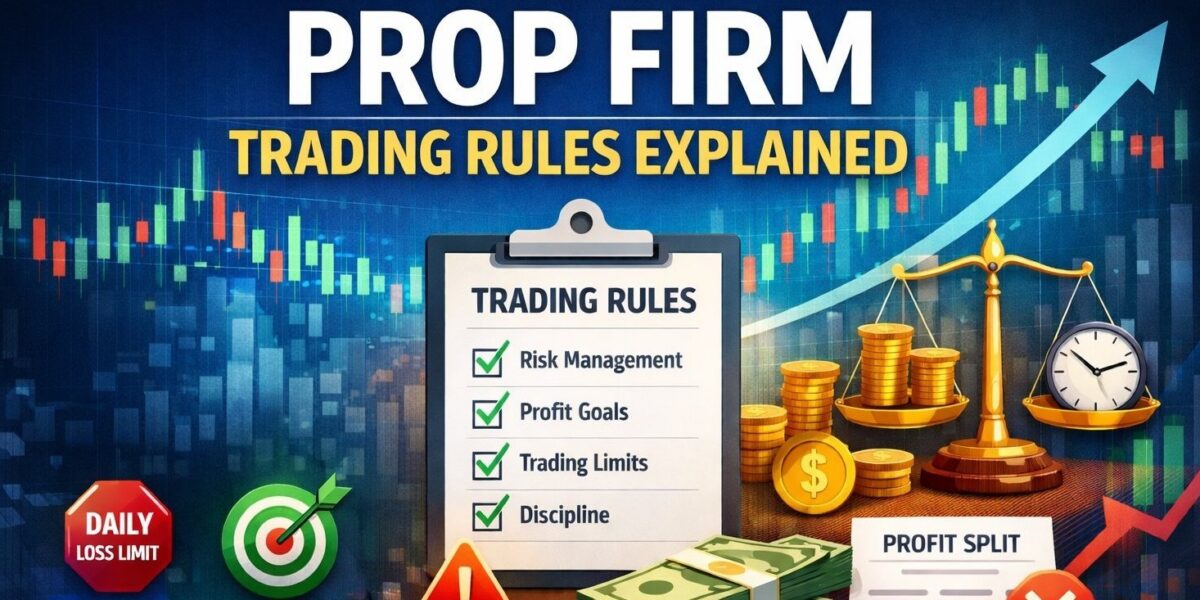
Entering the world of proprietary trading offers an incredible opportunity to trade with significant capital, but it comes with a strict set of conditions. Prop firm trading is not a free-for-all; it is a highly structured environment designed to identify skilled traders while protecting the firm’s capital. Understanding and strictly adhering to prop firm trading rules is the absolute foundation of a successful career in this industry. Many talented traders fail evaluations not because their strategies are unprofitable, but because they misunderstand or ignore the fine print.
Whether you are attempting to pass an evaluation or you are already managing a funded trading account, the rules dictate every aspect of your trading behavior. From how much you are allowed to lose in a single day to when you are permitted to hold positions, these regulations are hard-coded into the firm’s risk management software. This comprehensive guide will break down the most critical proprietary trading rules, helping you navigate the complexities of risk limits, performance metrics, and trading restrictions so you can secure your funding and keep it.
In the competitive landscape of Prop Firm Trading, consistency matters just as much as profitability. Traders must demonstrate discipline, patience, and a deep understanding of risk management to succeed. One small mistake, such as breaching a daily loss limit, can instantly disqualify you from the program. This is why mastering the rules of Prop Firm Trading is not optional—it is essential. As you progress, adapting your strategy to align with these requirements will significantly increase your chances of long-term success in Prop Firm Trading and help you build a sustainable trading career.
Mastering Risk Management Limits : Prop Firm Trading
The core of all prop trading challenge rules revolves around risk management. Prop firms are essentially risk management companies that outsource their trading execution to retail traders. Therefore, their primary concern is ensuring that no single trader can cause catastrophic damage to the firm’s overall capital pool. To achieve this, they implement strict drawdown limits that act as automated circuit breakers.
If you breach any of these risk limits, your account will be immediately terminated, regardless of how much profit you may have accumulated prior to the breach. Understanding exactly how these limits are calculated—whether they are based on your starting balance or your floating equity—is the most important step in developing a compliant trading strategy.
In Prop Firm Trading, these risk parameters are non-negotiable and are enforced in real time through advanced monitoring systems. Traders must constantly track their performance to ensure they remain within acceptable limits. Even a temporary spike in losses can trigger a violation, which is why precision and control are critical. Successful traders in Prop Firm Trading build their strategies around these restrictions rather than treating them as obstacles. By aligning your approach with these rules and maintaining strict discipline, you not only protect your account but also position yourself for long-term growth in Prop Firm Trading environments.
The Daily Loss Limit Explained
The daily loss limit is the maximum amount your account equity is permitted to drop within a single 24-hour trading period. This rule is designed to prevent traders from “tilting”—a psychological state where a trader suffers a loss and immediately takes reckless, over-leveraged trades in an attempt to win the money back. The daily limit typically ranges from 3% to 5% of your account balance.
It is crucial to understand how your specific firm calculates this limit. A balance-based daily limit only counts closed trades against your daily allowance. However, an equity-based daily limit (which is much more common) includes your floating, unrealized losses. If you have a $100,000 account with a 5% equity-based daily limit, and your open trades float to -$5,000 at any point during the day, you will lose the account, even if the trades eventually bounce back and close in profit.
In Prop Firm Trading, mastering the daily loss limit is one of the most important skills a trader can develop. It requires not just technical knowledge but also emotional control and strict adherence to a predefined risk plan. Many traders fail in Prop Firm Trading simply because they underestimate how quickly floating losses can accumulate. By carefully managing position sizes, setting appropriate stop losses, and avoiding impulsive decisions, you can stay within safe limits. Ultimately, success in Prop Firm Trading depends on respecting these boundaries and treating capital preservation as your top priority.
Navigating the Maximum Drawdown Limit
While the daily limit protects against a single bad day, the maximum drawdown limit (often referred to as the overall drawdown rule) protects the firm against a prolonged losing streak. This limit dictates the absolute maximum amount you can lose from the account’s peak value, typically set between 6% and 10%.
In Prop Firm Trading, understanding how maximum drawdown works is critical for long-term survival. Unlike the daily limit, this rule tracks your performance over time and adjusts based on your highest account balance. For example, if your account grows, your drawdown threshold may trail behind your peak equity, tightening the margin for error. Many traders overlook this and unknowingly violate the rule after a series of small losses. Success in Prop Firm Trading requires maintaining steady growth while protecting profits already made. By managing risk carefully and avoiding unnecessary exposure, traders can stay within limits and build consistency. Ultimately, mastering drawdown control is a key factor in sustaining profitability in Prop Firm Trading.
The calculation method for the maximum drawdown is the most heavily debated topic in prop trading. A static drawdown remains fixed based on your initial starting balance. For example, on a $100,000 account with a 10% static drawdown, your account is breached if your balance drops to $90,000. Conversely, a trailing drawdown moves up as your account reaches new high-water marks. If you make $5,000 in profit, your trailing drawdown level also moves up by $5,000, effectively penalizing you for giving back open profits.
Understanding Performance and Time Requirements
Beyond simply not losing money, prop firms require you to demonstrate that you can actually generate a return. The funded trader requirements dictate the specific performance milestones you must achieve to pass an evaluation and the ongoing metrics you must maintain once funded.
These rules are designed to filter out traders who get lucky on a single massive trade and to identify those who possess a repeatable, statistical edge in the markets. Balancing the need to hit profit targets while strictly adhering to time constraints and consistency rules is the true test of a professional prop trader.
Hitting the Profit Target Requirement
During the evaluation phase, the most prominent rule is the profit target requirement. This is the specific percentage of profit you must generate to prove your trading competency. In a typical two-step evaluation, Phase 1 might require an 8% profit target, while Phase 2 requires a 5% target.
It is vital to remember that this target must be achieved without ever breaching the daily or maximum drawdown limits. Many novice traders increase their risk exponentially as they get closer to the profit target, only to hit a drawdown limit and fail the challenge entirely. Once you are fully funded, the hard profit target is usually removed, and your goal shifts to generating enough profit to qualify for prop firm payouts.
Time Constraints: Minimum and Maximum Trading Days
Prop firms use time constraints to ensure traders are actively participating in the markets and not just passing challenges through sheer luck. The minimum trading days rule requires you to execute trades on a set number of individual days (typically 3 to 10 days) before you can pass an evaluation or request a payout. This prevents a trader from passing a challenge with one lucky trade on day one and immediately demanding a funded account.
Conversely, the maximum trading days rule dictates the time limit you have to hit your profit target during an evaluation (historically 30 to 60 days). However, a major positive trend in the industry is the removal of maximum time limits. Many top-tier firms now offer unlimited time to pass evaluations, allowing traders to wait for high-probability setups rather than forcing trades as a deadline approaches.
The Importance of the Consistency Rule
One of the most misunderstood trading performance metrics is the consistency rule. This rule is implemented to ensure that your profits are the result of a steady strategy rather than a single, high-risk gamble. A common consistency rule states that no single trading day can account for more than 30% or 50% of your total profit.
If you make $10,000 in total profit, but $6,000 of that came from one massive news trade, you would violate a 50% consistency rule. To pass the evaluation or receive a payout, you would need to continue trading using normal risk parameters until that $6,000 represents less than 50% of your total accumulated profit. This rule forces traders to demonstrate a repeatable edge over a larger sample size of trades.
Navigating Specific Trading Restrictions
Even if you manage your risk perfectly and hit your profit targets, you can still lose your account if you violate specific trading restrictions. Prop firms impose these rules to prevent traders from exploiting market anomalies or taking on risks that the firm’s liquidity providers cannot handle.
These restrictions govern how you execute your trades, the size of your positions, and when you are allowed to be active in the market. Ignorance of these rules is never accepted as an excuse, and violations are usually detected automatically by the firm’s trading servers.
Leverage Restrictions and Lot Size Limits
To prevent traders from taking on excessive risk, firms implement strict leverage restrictions. While retail forex brokers might offer 1:500 leverage, prop firms typically restrict leverage to 1:30 or 1:100. This lower leverage forces traders to use proper position sizing and prevents them from risking the entire account on a few pips of movement.
Additionally, some firms enforce specific lot size limits. These rules dictate the maximum position size you can take on a single trade or across all open trades combined. These limits are usually scaled based on your account size, ensuring that your risk exposure remains proportional to the capital you are managing.
News Trading Restrictions and Holding Rules
Market volatility spikes dramatically during major economic announcements, creating conditions where slippage can cause losses that exceed standard drawdown limits. To mitigate this, many firms enforce strict news trading restrictions. A common rule prohibits opening or closing trades within a 4-minute window (2 minutes before and 2 minutes after) of a high-impact, Tier-1 news release like Non-Farm Payrolls (NFP) or CPI data.
Furthermore, you must be aware of weekend holding rules and overnight position rules. Some firms require all trades to be closed before the market shuts down for the weekend to avoid the risk of massive price gaps when the market reopens on Monday. Similarly, certain firms impose trading session limits, requiring day traders to close positions before the end of the US session. If you prefer a trading style that doesn’t require passing an evaluation with these strict rules, an Instant Prop funding firm might be an alternative, though they still enforce strict risk management parameters. By thoroughly understanding and respecting all prop firm trading rules, you position yourself for long-term success and consistent profitability in the proprietary trading industry.