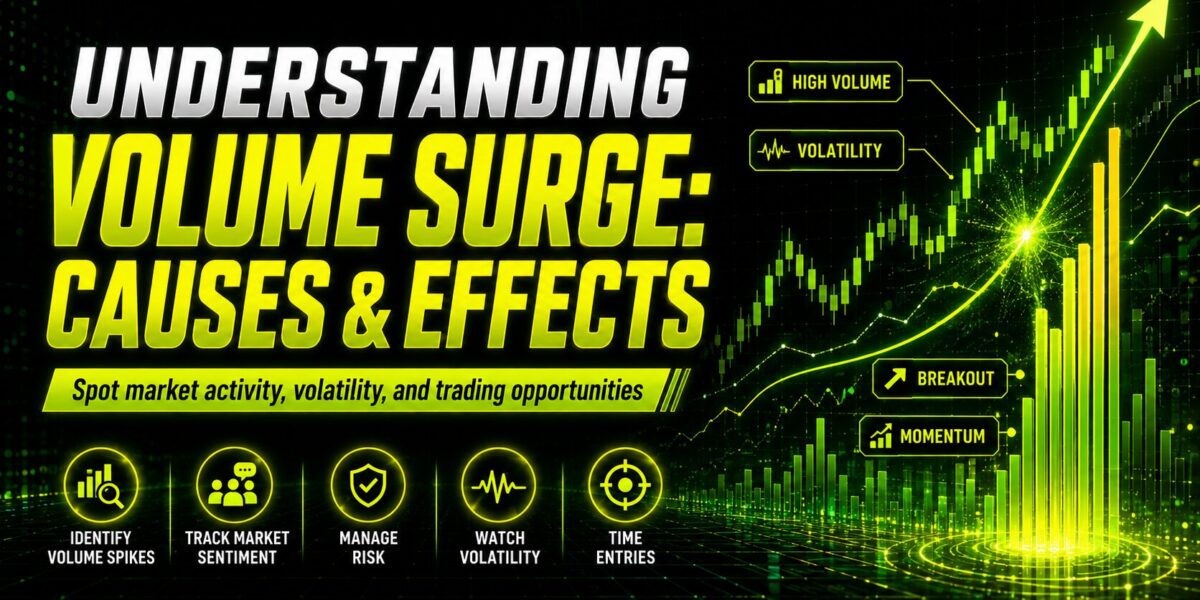
In the dynamic arena of modern financial markets, price movements often capture the immediate attention of market participants. However, experienced traders understand that price is only one dimension of market activity. To truly gauge the strength, validity, and sustainability of any market movement, one must analyze trading volume. Trading volume represents the total number of shares, contracts, or units traded during a specific time frame for a given financial instrument. When a sudden volume surge occurs, it signals a massive liquidity injection and a dramatic shift in market attention.
Understanding the dynamics of a volume surge in trading is essential for any market participant seeking to navigate volatility, manage risks, and capture trading opportunities. Whether you are trading forex pairs, commodities, indices, crypto, or a specific symbol on an equity exchange, a sharp increase in volume can completely reshape the liquidity conditions and order book dynamics in a short time period. This article provides an in-depth analysis of what a volume surge is, its underlying causes, and its profound effects on market behavior and trade execution.
1. What is a Volume Surge in Trading?
A volume surge refers to a period where the trading activity of a financial instrument experiences a sharp increase in volume that is significantly higher than its historical average over a comparable time frame. In technical charts, this phenomenon is often visually represented as a candle surge—a single price bar accompanied by a massive, vertical volume bar that dwarfs the surrounding trading activity. This sudden volume surge reflects a concentrated burst of transaction activity, where a massive number of trades are executed simultaneously.
In any liquid financial market, transaction volume represents the degree of conviction among buyers and sellers. When trading activity is normal, the market is in a state of relative equilibrium, with buyers and sellers matching orders efficiently. However, a sudden volume surge in trading indicates a major market imbalance. It reveals that new information has entered the market, forcing a rapid reassessment of value and triggering aggressive market orders from institutional and retail traders alike.
2. Market Dynamics Across Different Financial Instruments
While the core mechanics of a volume surge remain consistent, the way high trading volume manifests can vary significantly across different asset classes. Each financial instrument operates within its own structural and liquidity framework, influencing how market participants perceive and react to sudden spikes in volume.
Understanding Forex Pairs and Currency Volatility
In forex trading, there is no centralized exchange to report the exact number of contracts traded, as the market operates on a decentralized, over-the-counter (OTC) basis. Instead, forex volume is measured using “tick volume,” which counts the number of price updates or transactions within a given time frame. When a specific symbol or major currency pairs experience a volume surge, it typically reflects a massive influx of institutional capital, often driven by central banks or multinational corporations adjusting their portfolios. This liquidity injection can cause rapid shifts in currency value and trigger substantial market gaps.
Commodities, Indices, and the Role of Contracts
Unlike forex, commodities and stock indices are traded on centralized exchanges (such as the CME or NYSE) through standardized futures contracts or exchange-traded funds (ETFs). In these markets, a volume surge is measured by the precise number of contracts or shares traded. For commodities like crude oil or gold, a sharp increase in volume often points to supply-demand shocks or geopolitical developments. For indices, high trading volume indicates broad market participation, reflecting systemic shifts in global economies rather than individual company performance.
Crypto Markets and Round-the-Clock Activity
The crypto market operates 24/7, meaning that a volume surge can occur at any hour of the day or night. Due to the highly retail-driven nature of digital assets and the presence of numerous decentralized and centralized exchanges, crypto volume surges are often incredibly aggressive. These surges are heavily influenced by social media sentiment, algorithmic trading, and leveraged liquidations. Because liquidity can be fragmented across multiple platforms, a sudden volume surge on a single exchange can rapidly transmit to others, causing severe price discrepancies and high volatility across the entire asset class.
3. Primary Fundamental Causes of a Volume Surge
A sudden volume surge is rarely an accidental occurrence; it is almost always triggered by a catalyst that forces market participants to act quickly. These catalysts can be broadly categorized into fundamental events, economic data releases, and geopolitical shifts.
| Catalyst Category | Specific Events | Market Impact |
| Economic Reports | Non-Farm Payroll (NFP), CPI, GDP | Sudden volume surge, high volatility, price gaps |
| Monetary Policy | Interest rate decisions, FOMC press conferences | Sharp increase in volume, currency value shifts |
| Geopolitical Events | Geopolitical conflicts, trade wars, sanctions | Market gaps, flight to safe-haven assets |
| Corporate/Market Events | Earnings releases, major mergers, regulatory changes | Specific symbol volume surge, trend continuation |
Economic news releases, Employment reports, and the Power of the NFP
Among the most powerful catalysts for a volume surge in trading are scheduled economic news releases
. The monthly Non-Farm Payroll (NFP) report in the United States is a prime example. The NFP report provides a comprehensive snapshot of the health of the US labor market, which is a vital indicator for global economies
. When the actual NFP figures deviate significantly from the consensus forecast, it triggers an immediate reaction. Important employment reports like this have a history of driving massive trading activity. Thousands of algorithmic trading systems and retail traders enter the market simultaneously, resulting in a sudden volume surge, widened spreads, and rapid price adjustments across USD-denominated assets.
Monetary Policy and Central Bank Decisions
Central banks hold immense power over financial markets through their monetary policy decisions. Interest rate decisions, inflation data (such as Consumer Price Index or CPI releases), and statements from policymakers directly influence currency value and bond yields
. When central banks announce unexpected interest rate changes or signal a shift in their hawkish or dovish stance, it alters the fundamental valuation of a currency. This leads to a massive reallocation of capital, generating high trading volume as institutional investors adjust their long-term holdings to align with the new economic reality.
Geopolitical Conflicts and Global Economies
Geopolitical conflicts, trade disputes, and unexpected political events are major sources of market uncertainty. When geopolitical tensions escalate, they can disrupt supply chains, impact global economies, and threaten energy security. In response, market participants rush to hedge their portfolios or seek safe-haven assets like gold, Swiss Francs, or US Treasuries. This sudden flight to safety creates a massive volume surge in specific commodities and forex pairs, accompanied by high volatility and rapid shifts in market sentiment.
4. Technical and Behavioral Drivers of Volume Surges
While fundamental events provide the macro-level catalysts, the micro-level execution of trades is driven by technical indicators, algorithmic systems, and human psychology. These technical and behavioral factors can amplify a volume surge, turning a minor price adjustment into a massive market movement.
Sentiment Shifts and Traders’ Behavior
Market sentiment is a powerful force that reflects the collective psychology of all market participants. When a financial instrument breaks out of a long-term consolidation pattern, it captures widespread market attention. As the price moves, it triggers a cascade of behavioral responses. Fear of missing out (FOMO) drives retail traders to enter aggressive market orders, while institutional traders execute large blocks of shares or contracts. This collective shift in traders’ behavior feeds on itself, creating a self-reinforcing cycle of rising volume and accelerating price movement.
The Influence of Trading Cycles on Market Activity
Financial markets operate in distinct phases, often referred to as Trading Cycles. These cycles consist of accumulation, markup, distribution, and markdown phases. During the accumulation phase, institutional players quietly build positions, resulting in low volatility and steady volume. However, as the market transitions into the markup phase—often triggered by a breakout above a key resistance level—a sudden volume surge occurs. Understanding where an asset lies within these Trading Cycles allows traders to anticipate when volume is likely to spike and position themselves accordingly.
Plain Text
Market Phase Transition: Price | / (Markup Phase: Sudden Volume Surge) | / | _ _ _ _ _ _ _/ | (Accumulation Phase: Low Volume) +———————————— Time
Algorithmic Trading and Automated Order Execution
In today’s financial markets, algorithmic trading accounts for a vast majority of daily trading volume. High-frequency trading (HFT) systems are programmed to scan the order books of various financial instruments for liquidity imbalances and price discrepancies. When a technical level is breached or an economic news release hits the wires, these algorithms can execute thousands of orders in milliseconds. This automated trade execution can rapidly deplete the available liquidity at a specific price level, causing a sharp increase in volume and driving the market into a state of high volatility.
5. Direct Effects of a Volume Surge on Market Structure
A sudden volume surge does not just move prices; it temporarily alters the very structure of the market and the behavior of order books. Understanding these structural changes is critical for managing risk and ensuring proper trade execution.
Liquidity Conditions and the Phenomenon of Price Gaps
Under normal market conditions, liquidity is plentiful, and the bid-ask spread is narrow. However, during a sudden volume surge, the demand for immediate execution can far outstrip the available supply. In less active markets, infrequent price movements are common, but a sudden volume surge changes this dynamic instantly. When a massive market order is executed, it can instantly clear out all the limit orders at the current price level. This creates price gaps—also known as market gaps—where the price jumps from one level to another without any trading occurring in between
. These internal price gaps are a direct result of a temporary market imbalance where liquidity is completely depleted.
Widened Spreads and Their Impact on Trading Costs
In highly volatile conditions, liquidity providers (such as market makers and investment banks) face increased risk. To protect their capital from rapid, adverse price movements, they will widen their spreads
. Widened spreads mean that the difference between the bid and ask price increases significantly. For a trader, these wide spreads represent a direct increase in trading costs, making it more expensive to enter and exit positions during a volume surge.
Trade Execution Challenges: Slippage and Delayed Orders
One of the most frustrating effects of a volume surge for traders is the difficulty of achieving precise trade execution. When the market is moving at extreme speeds, several execution issues can arise:
1.Slippage: Slippage is the difference between the expected price of a trade and the actual price at which the order is filled
. In a fast-moving market, your market order may be executed at a much worse price than what was displayed on your screen.
2.Delayed Orders: The sheer volume of incoming orders can overwhelm a broker’s execution engine, leading to delayed orders. A delay of even a few milliseconds can result in a completely different fill price.
3.Rejected Orders: In extreme cases, if the price moves too quickly, your broker may return a “requote” or reject your order entirely because the requested price is no longer available in the market.
These challenges often lead to unexpected outcomes for retail traders who are not prepared for the rapid shifts in liquidity.
6. Risk Management and Strategic Opportunities
Navigating a volume surge requires a balance between capital protection and opportunistic trading. While the high volatility associated with volume spikes presents significant risks, it also creates highly profitable trading opportunities for those who know how to manage their exposure.
Capital Protection and the Role of Stop-Loss Orders
In volatile markets, capital protection must be a trader’s absolute priority. The primary tool for managing risk is the stop-loss order. However, during a volume surge, standard stop-loss orders can suffer from bad market order fills due to slippage and market gaps
. To mitigate this risk, traders must understand the difference between order types:
•Market Stop-Loss: Triggers a market order once your stop price is hit. It guarantees that your position will be closed, but does not guarantee the execution price, exposing you to potential slippage.
•Guaranteed Stop-Loss: Offered by some brokers, this order guarantees execution at your exact stop price, regardless of market gaps, though it typically incurs a higher fee or premium.
•Limit Orders: Placing limit orders instead of market orders can prevent negative slippage, ensuring that you only buy or sell at your specified price or better, though there is a risk that your order will not be filled if the market moves too quickly.
Traders must also establish robust risk management protocols, such as reducing their position sizes during high-impact economic news releases, setting clear Stop Loss (SL) and Take Profit (TP) levels before entering any trade, and utilizing pending orders (like buy limits or sell limits) to control entry prices and minimize slippage.
Capitalizing on Trend Continuation and Reversals
For disciplined traders, a volume surge is a beacon of opportunity. A sharp increase in volume on a breakout confirms strong market sentiment and suggests a high probability of trend continuation. Conversely, an exhausting volume surge at the end of a prolonged trend—known as a buying or selling climax—often signals that the market has run out of participants, paving the way for a sharp reversal. By analyzing volume in conjunction with price action, traders can identify high-probability entry and exit points.
The Role of an Instant Prop Funding Firm in Volatile Markets
For retail traders who possess the skills to navigate volume surges but lack sufficient capital, partnering with an instant prop funding firm can be highly beneficial. An instant prop funding firm provides traders with access to funded accounts, allowing them to trade larger positions in highly liquid markets. Because these firms emphasize strict risk management and capital protection rules, trading under their framework encourages disciplined SL/TP execution. This partnership enables talented traders to capitalize on the massive trading opportunities generated by volume surges without risking their own personal capital.