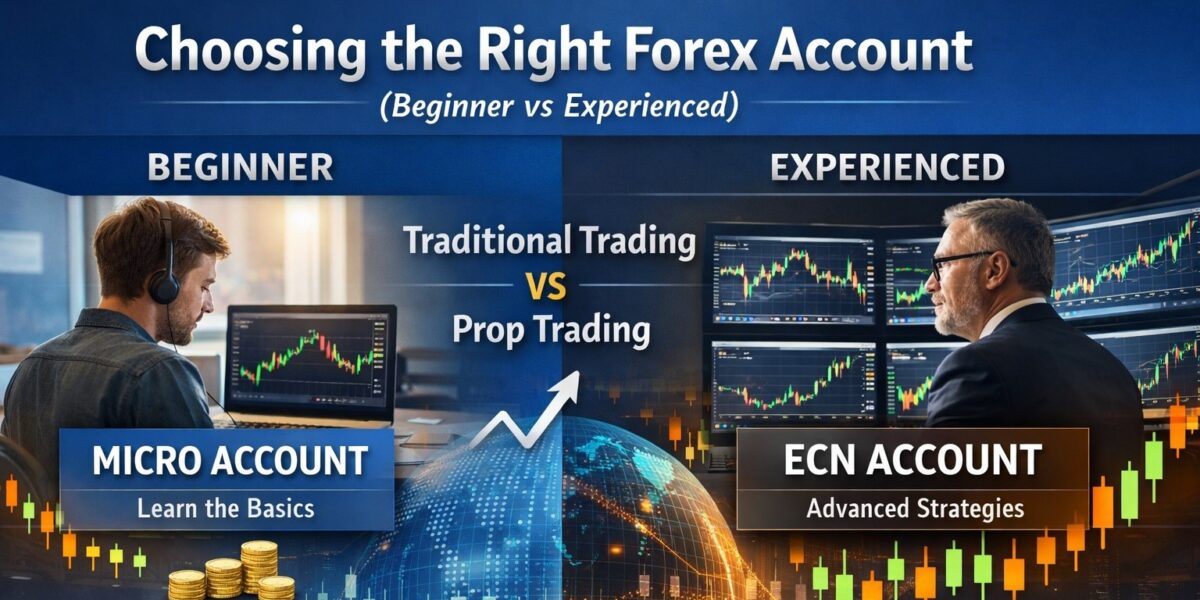
The global foreign exchange market offers unparalleled opportunities for individuals looking to build wealth through currency trading. However, before executing your first trade, you must make a foundational decision that will significantly impact your journey: choosing the right forex account. The account type you select dictates your risk exposure, trading costs, and the tools available to execute your strategy. Whether you are a novice taking your first steps or a seasoned professional seeking better conditions, understanding the nuances of different Forex trading accounts is essential for long-term success.
In today’s dynamic financial landscape, brokers offer a wide array of account types tailored to different experience levels and capital sizes. From accounts designed to minimise risk for beginners to sophisticated setups that provide direct market access for veterans, the choices can be overwhelming. Selecting the right Forex account is not just about starting your journey—it plays a crucial role in shaping your trading performance and long-term success.
This comprehensive guide will explore the various account options, helping you align your choice with your financial goals, risk tolerance, and overall trading approach. Whether you are just entering the market or refining your strategy, understanding each Forex account type will enable you to make informed decisions, manage risk effectively, and maximise your potential in an ever-evolving trading environment.
Understanding the Basics of Forex Trading Accounts
Before diving into the specific account types, it is crucial to understand the fundamental mechanics that differentiate them. A Forex account is essentially your gateway to the market, provided by a broker or Forex broker. It holds your capital or initial deposit and provides the interface through which you buy and sell currency pairs in real time.
The type of Forex account you open determines several key factors, including the minimum trade size you can execute, the spreads and commissions you will pay, and how your orders are processed in the market. Understanding these core differences will help you choose an account that aligns with your trading style, risk tolerance, and overall financial objectives.
For beginners, the primary focus should be on risk mitigation and learning the mechanics of the market without exposing large amounts of capital. Experienced traders, on the other hand, prioritise execution speed, lower costs, and advanced analytical tools. By evaluating your current skill level and financial resources, you can make an informed decision that supports your trading objectives.
The Importance of Capital and Initial Deposit
Your capital or initial deposit is the lifeblood of your trading business, especially when managing a Forex account. It determines the size of the positions you can take and your ability to withstand market fluctuations without unnecessary risk. The strength of your Forex account largely depends on how well you allocate and protect this capital over time.
Different account types come with varying minimum deposit requirements. Beginners often start with smaller amounts to test the waters and gain practical experience, while experienced traders typically require larger capital bases to implement advanced strategies and aim for more substantial returns. Regardless of your level, it is vital to only trade with risk capital—money you can afford to lose without affecting your standard of living or financial stability.
Navigating Trading Costs: Spreads and Commission
Every time you place a trade, you incur costs, and these costs directly impact the performance of your Forex account. These costs primarily come in two forms: spreads and commissions. The spread is the difference between the bid and ask price of a currency pair, while a commission is a fixed fee charged per trade.
Beginner-friendly setups within a Forex account typically feature wider spreads with no commission, making the pricing structure simpler and easier to understand. In contrast, more advanced structures within a Forex account often provide raw, ultra-tight spreads but apply a commission on every transaction.
Understanding these trading costs is critical for maintaining profitability, especially for high-frequency traders, as even small fees can accumulate quickly and significantly affect the overall performance of your Forex account.
Account Types Tailored for Beginners
When you are just starting, the primary goal is education and survival. The forex market is highly volatile, and inexperienced traders can quickly deplete their accounts if they are not careful. Brokers recognise this and offer specific account types designed to provide a safer environment for learning. These accounts allow you to trade with smaller position sizes, reducing the financial impact of inevitable mistakes as you develop your skills.
Choosing an account that aligns with your beginner status is a crucial step in choosing the right forex account. It allows you to focus on mastering your strategy and understanding market dynamics without the overwhelming pressure of significant financial risk.
The Value of a Demo Account
Before risking any real money, every aspiring trader should start with a Demo account. This account provides simulated funds in a live market environment, allowing you to practice executing trades, testing strategies, and familiarising yourself with the Trading platform. A demo account is an invaluable tool for building confidence and understanding how different currency pairs react to economic news and events. It is the ultimate risk-free training ground.
Starting Small with a Micro Account
Once you are ready to transition to live trading, a Micro account is often the best choice. In a micro account, the standard Lot size is 1,000 units of base currency, which is significantly smaller than a standard lot. This allows you to trade with a very small Capital / Initial deposit, often as low as $10 or $50. The primary advantage of a micro account is that it allows you to experience the psychological pressures of trading real money while keeping your absolute financial risk extremely low.
Stepping Up to a Mini Account
As you gain consistency and confidence, you might consider upgrading to a Mini account. A mini lot represents 10,000 units of base currency. This account type serves as a bridge between micro and standard trading. It requires a slightly larger initial deposit but offers a more realistic trading experience in terms of profit and loss fluctuations. A mini account is ideal for traders who have developed a reliable strategy and are ready to take on slightly more risk to generate meaningful returns.
Advanced Accounts for Experienced Traders
Experienced traders have different requirements than beginners. They have proven strategies, larger capital bases, and a deep understanding of market mechanics. For these individuals, the focus shifts from risk mitigation to optimising execution and minimising costs. They require accounts that offer direct access to liquidity, ultra-fast execution speeds, and the ability to trade large volumes efficiently.
For professionals, choosing the right forex account often involves evaluating the technological infrastructure of the broker and the depth of the liquidity pool they provide.
The Power of the Standard Account
The Standard account is the traditional choice for well-capitalised, experienced traders. In this account, a standard Lot size is 100,000 units of base currency. Trading standard lots requires a significant capital base and a robust understanding of Risk management. While the potential for profit is substantial, the risk of loss is equally high. Standard accounts often offer competitive spreads and access to a wide range of trading instruments, making them suitable for comprehensive, multi-asset strategies.
Direct Access with an ECN Account
For the most demanding professionals, an ECN account (Electronic Communication Network) is the gold standard. ECN accounts connect traders directly with Liquidity providers, such as major banks and financial institutions, bypassing the broker’s dealing desk. This results in raw, ultra-tight Spreads and lightning-fast Order execution. While ECN accounts charge a Commission per trade, the overall Trading costs are often lower for high-volume traders. This account type is essential for scalpers and algorithmic traders who rely on precise entry and exit points.
Specialised Account Options
Beyond the standard progression of account types, the forex industry offers specialised accounts to accommodate specific religious beliefs or alternative funding models. These options ensure that the market is accessible to a diverse range of participants, regardless of their background or capital constraints.
Understanding these specialised options is an important aspect of choosing the right forex account, as they provide unique solutions to common trading challenges.
Understanding the Islamic Account / Swap-Free Account
For traders who adhere to Islamic finance principles, earning or paying interest is prohibited. To accommodate this, brokers offer an Islamic account / Swap-free account. In standard trading, holding a position overnight incurs a rollover fee or swap, which is essentially an interest payment based on the interest rate differential between the two currencies. An Islamic account eliminates these overnight fees, ensuring compliance with Sharia law while allowing traders to hold positions for extended periods.
Exploring Prop Firm Opportunities
An alternative to trading your own capital is partnering with an Instant Funding Prop Firm. Proprietary trading firms provide skilled traders with access to significant company capital in exchange for a share of the profits. This model eliminates the need for a large personal deposit and provides a structured environment with strict risk parameters. For a deeper understanding of how this compares to standard retail trading, you can explore the differences between traditional trading vs prop trading.
Aligning Your Account with Your Trading Strategy
Your chosen Trading strategy should heavily influence your account selection. Different strategies require different market conditions, execution speeds, and cost structures to be profitable. A mismatch between your strategy and your account type can severely hinder your performance, regardless of your skill level.
When choosing the right forex account, you must carefully analyse how you intend to interact with the market and select the environment that best supports your approach.
Matching Strategy to Market Conditions
Different account types perform better under specific Market conditions / volatility. For example, scalpers who aim to profit from small, rapid price movements require the tight spreads and fast execution of an ECN account. Conversely, swing traders who hold positions for days or weeks might prefer a standard account where wider spreads are less impactful on their overall profit margin. Understanding how your strategy performs in varying volatility is crucial for selecting the right account. Furthermore, choosing the best forex currency pairs to trade in 2026 that align with your account type and strategy is essential for maximising your opportunities.
The Role of Leverage and Risk Management
Leverage is a double-edged sword in forex trading. It allows you to control large positions with a relatively small amount of capital, amplifying both potential profits and potential losses. Beginner accounts often offer higher leverage to compensate for small deposits, but this requires strict Risk management to avoid catastrophic losses. Experienced traders often use lower leverage, relying on their larger capital base and refined strategies to generate consistent returns. Regardless of your experience level, understanding how to use leverage responsibly is paramount.
Making the Final Decision
Choosing the right forex account is not a one-size-fits-all process. It requires a brutally honest assessment of your current skill level, financial resources, and long-term goals. By carefully evaluating the different Forex trading accounts available, you can create a solid foundation for your trading career.
Remember that your needs will evolve as you gain experience in Forex Trading. The account that is perfect for you today may not be suitable in a year’s time. Whether you’re exploring Traditional Trading vs Prop Trading or simply starting out, it’s important to continuously reassess your trading environment and strategy.
Do not hesitate to upgrade or change your account type as your skills and capital grow. Whether you choose a micro account to learn the ropes or an ECN account to execute complex strategies, the right choice will empower you to navigate the forex market with confidence and discipline.